One of Southern Maine’s Largest Forested Parcels is Conserved
One of Southern Maine’s Largest Forested Parcels is Conserved
A landmark conservation effort preserves 650 acres of forest and freshwater habitat, advancing permanent conservation across the Mousam River watershed.
Alfred, Maine — July 29, 2026 — Maine Coast Heritage Trust (MCHT) and the Maine Department of Inland Fisheries & Wildlife (MDIFW) have finalized the conservation of Gebung Woods, a 650‑acre forest in Alfred that anchors a major collaborative effort to conserve the Mousam River watershed in Southern Maine. The property was officially transferred to MDIFW on June 29, 2026, and will be managed for wildlife habitat and open to the public for outdoor recreation.
Gebung Woods is one of the largest remaining undeveloped parcels in the watershed, protecting more than two miles of frontage along the Middle Branch of the Mousam River and its tributaries. The forest includes important young, regenerating hardwood stands, intact riparian buffers of mature trees, and a mosaic of seeps, pools, and wetlands. Together, these habitats support nearly a dozen rare, threatened, and endangered species — including the Eastern Black Racer (Coluber constrictor) and rare plants such as upright bindweed (Calystegia spithamaea) and spicebush (Lindera benzoin).
“This is an extraordinary opportunity to strengthen ecological integrity in a part of Maine where biodiversity abounds, but large natural areas are increasingly threatened by fragmentation,” said Chris Schorn, Southern Maine project manager for MCHT. “Gebung Woods will serve as a foundation for our long‑term conservation work on the Mousam River by allowing us to preserve intact forests and create new opportunities for public access and community connection with this vital river.”
The project is part of MCHT’s Rivers Initiative, a coast‑wide effort to protect and restore key coastal rivers and improve the long‑term health of the Gulf of Maine ecosystem. Under MDIFW’s stewardship, Gebung Woods will be part of Maine’s 140,000 acres of wildlife management areas. These wildlife management areas are open to the public for a variety of outdoor recreational activities and are managed to protect and enhance important wildlife habitats.
“Gebung Woods contains critical habitat for a suite of rare species in Southern Maine,” said Bethany Atkins, MDIFW Habitat Conservation Section Supervisor. “The entire parcel is within the Walnut Hill Focus Area, identified by the Beginning with Habitat program as an area of statewide importance due to its biological diversity, containing a high concentration of at-risk species and habitats. We’re grateful for the partnership that made this possible and look forward to stewarding this land for wildlife and for the people who will benefit from its conservation for generations to come.”
MDIFW will be developing a management plan that will include maintaining riparian buffers, implementing strategies to maintain or improve habitat for critical species, enhancing biological diversity, and supporting opportunities for hunting, fishing, and outdoor recreation. Public access details will be shared once the plan is complete.
MCHT purchased the property from North Country Land, Inc. on May 18, 2026, and the final closing with MDIFW occurred on June 29, 2026, officially transferring ownership to the state agency.
Funding for the project reflects a 50/50 partnership between MCHT and the State of Maine. MCHT’s contribution includes support from its Rivers Initiative, funded in part by the Ram Island Conservation Fund and the Morton-Kelly Charitable Trust. The state’s contribution includes funding from the federal Pittman‑Robertson Act, which supports wildlife conservation and habitat protection nationwide.
About Maine Coast Heritage Trust
Maine Coast Heritage Trust (MCHT) advances the conservation of lands and waters in Maine to ensure ecological wellbeing and foster thriving communities. Since 1970, we have worked to guide the conservation movement and support a network of more than 80 land trusts. Together with partners, we’ve conserved over 200,000 acres and 341 coastal islands, supporting the needs of people, plants, animals, and ecosystems across the coast. We’re dedicated to ensuring that our natural areas can mitigate the effects of climate change and support all people and life for generations to come. Learn more at mcht.org.
About The Maine Department of Inland Fisheries and Wildlife
Maine Department of Inland Fisheries and Wildlife (MDIFW) preserves, protects, and enhances the inland fisheries and wildlife resources of the state. Established in 1880 to protect big game populations, MDIFW has since evolved in scope to include protection and management of fish, non-game wildlife, and habitats, as well as restoration of endangered species like the bald eagle. In addition to its conservation duties, MDIFW is also responsible for enabling and promoting the safe enjoyment of Maine’s outdoors — from whitewater rafting to boating, snowmobiling, hunting, fishing, and wildlife observation.
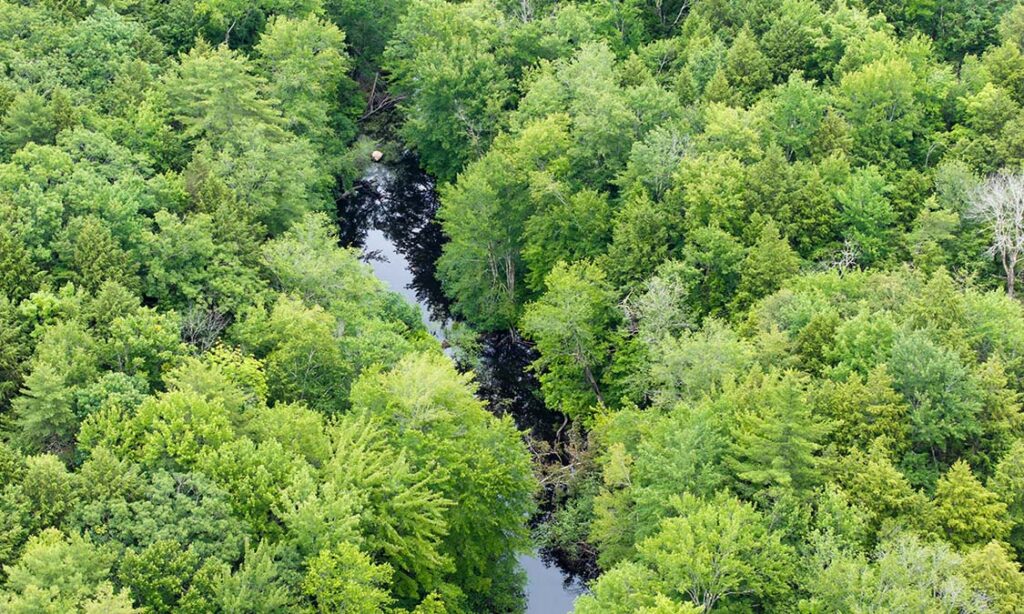
Gebung Woods — a newly conserved 650‑acre forest in Alfred — is one of the largest remaining undeveloped parcels in the Mousam River watershed. Aerial photo by Ryan Smith, Rooted In Light Media, courtesy of Maine Coast Heritage Trust.