On Work
Voices from the Coast: On Work
In celebration of Maine Coast Heritage’s 50th year, people share their visions of and for the Maine coast.
work /wərk/ 1. activity involving mental or physical effort done in order to achieve a purpose or result.
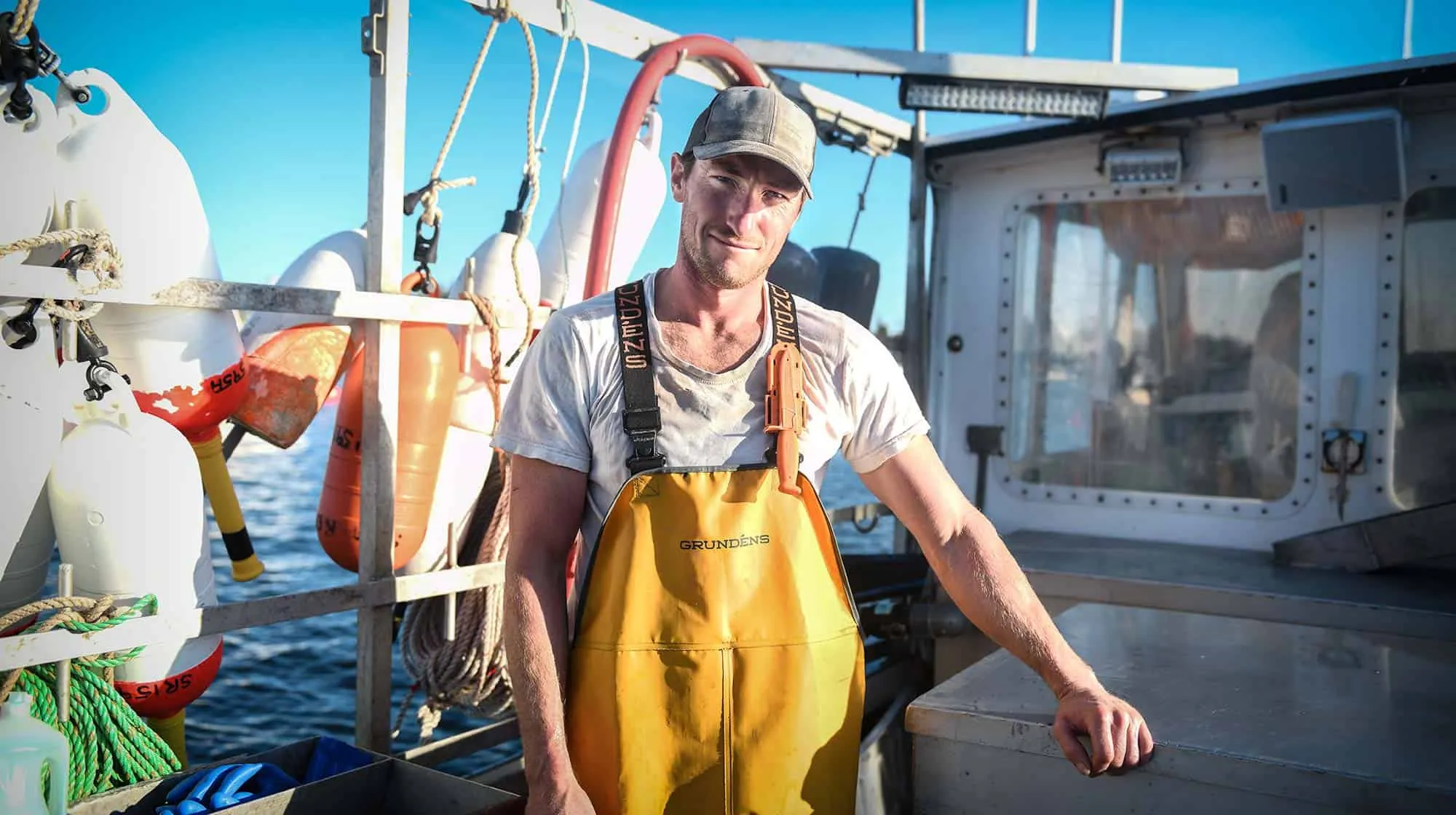
Photo by Courtney Mooney
I love living on and next to the water. I can’t really imagine not living here. The islands have a strong connection to the ocean: we’re shaped by it and we depend on it. At the same time, our ocean is changing in ways that threaten this tenuous relationship…in terms of plastics, pollution, and climate. Lobstering is kind of the only thing that we have left.
– Sam Rosen
“A century ago, many more people inhabited the islands in this area. Industry was more robust and diverse. People did lots of things—from quarrying to farming—and every species supported a commercial fishery. Now, you go lobstering, care-take for a summer person, or you’re employed in a trade like plumbing or construction.
“A lot of the young people are leaving. I guess what I’d like to see here is a kind of healthy population of young people that really want to be here and give back to the community. It’s a great place to live, but there are a lot of things that could change to help our future.
“I like to go to the outer islands and pick up trash out there. I started in high school. I take my skiff out and load it up with trash from the beach. My father gets into it too. Lobstering makes a lot of trash and most fishermen are really good about not throwing anything overboard, but there are a few that mess it up for everyone else…and everyone’s buoys end up on the beach at some point—there’s no real way around it. I guess it’s just one way to try to minimize your impact.”
Sam is a lifelong resident of Vinalhaven, where he works as a lobsterman and halibut fisherman. An advocate for the ocean and all things wild, he works as a scuba instructor and travels as much as possible.
Courtney Mooney (see above photograph) is a Maine-based photographer and visual activist. She’s a twelfth-generation Mainer whose connection to her birthplace has given her a unique opportunity to give back to it. Mooney’s work is primarily concentrated on the environment.
Braving the Elements
by Ann (Mason) Trainor Domingue
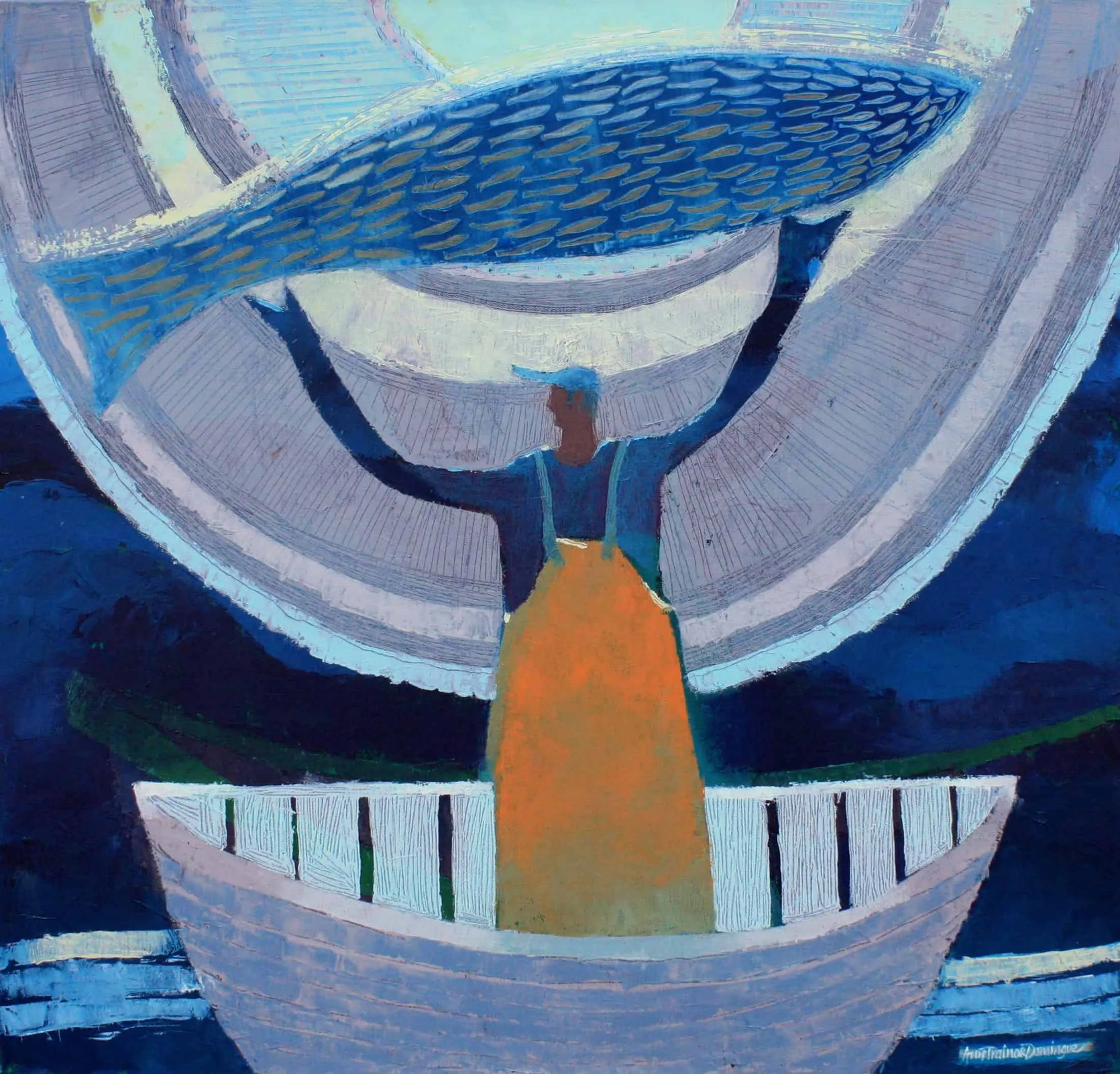
Ann (Mason) Trainor Domingue, Braving the Elements, 2019, acrylic on canvas, 24 x 24 inches
Ann (Mason) Trainor Domingue was born in Fall River, Massachusetts. She resides in New Hampshire, not far from the New England coastal environs that continue to inspire her work. Ann is a Copley Artist in the Copley Society of Art.
Mind of a Fisherman
By Richard P. Alley
Honest smiles clear skies
and calm seas. These are the
things a fisherman always
sees.
But in his soul he really
knows of the raging seas,
gray skies and wind that
blows.
He lives his life out on
the edge, like crashing
seas on a rocky ledge.
It’s islands and birds
he loves the most, and his
free spirit working along
the rocky coast.
The spirit of his ancestors
are still there too, working
along as they used to do.
He sees them in his mind
almost every day, and that
is why he loves earning his
living this way.
Richard P. Alley lives in Addison, Maine, and has been fishing for over 50 years out of the family homestead in West Jonesport, an old bait-shack turned fishermen’s cottage that’s been in his family since 1880. He’s been writing poetry for as long as he can remember.
Boathouse
by Lydia Cassat

Lydia Cassatt, Boathouse, Brooksville, 2017
Lydia Cassatt‘s photographs are taken with an iPhone 7plus and the Hipstamatic App. “My best work comes from observing the landscape on my walks and drives in Brooksville and coastal Maine. I seek the solace of nature and try to convey harmony and balance in my photos.”
Love of Place, Sense of Planet
by Molly Holmberg
Molly Holmberg
Imagine sitting on a pebbly pocket beach. The sound of the stones being pushed and pulled by crashing waves is the sound of each particular stone in that one small cove, but also the sound of the moon pulling on the ocean, the sound of gravity operating in the universe.
On the Maine coast, there are so many places where the intimate meets the mythic that can help us expand our understanding of scale. For me, many of these places are out on Monhegan Island, where my great-grandparents built a summer cottage down on the rocky ledges of Dead Man’s Cove.
More so than in my daily life, the hours I spend on Monhegan swing between experiencing the tiny and the vast. Nearly every day I spend out there, I spend time in the intertidal world.
I flip rockweed in search of green crabs or dive a few feet down to grab larger Jonah crabs clinging to their bright fields of Irish moss. I watch barnacles rhythmically sweep for food, the sugar kelp arch and wave, and the moon jellies drift. I squat beside a high tide pool, mesmerized by the clusters of tiny, blue seashore springtails wriggling into endless formations on the surface.
And then, just by lifting my eyes to the horizon, a whole vast surface of ocean lies before me. And then, with a little rowing, I can be atop nearby Manana Island, with nothing in the foreground waters but a last boat or two trying for tuna, watching the blinding sun go down over the mainland, over the rest of the country, continent, planet.
We are constantly in a precise place and in the vast, shifting universe. To me, our ability to imagine these scales nesting within each other, as part of each other, is one of our biggest creative responsibilities at this time. I know it’s my job as an artist.
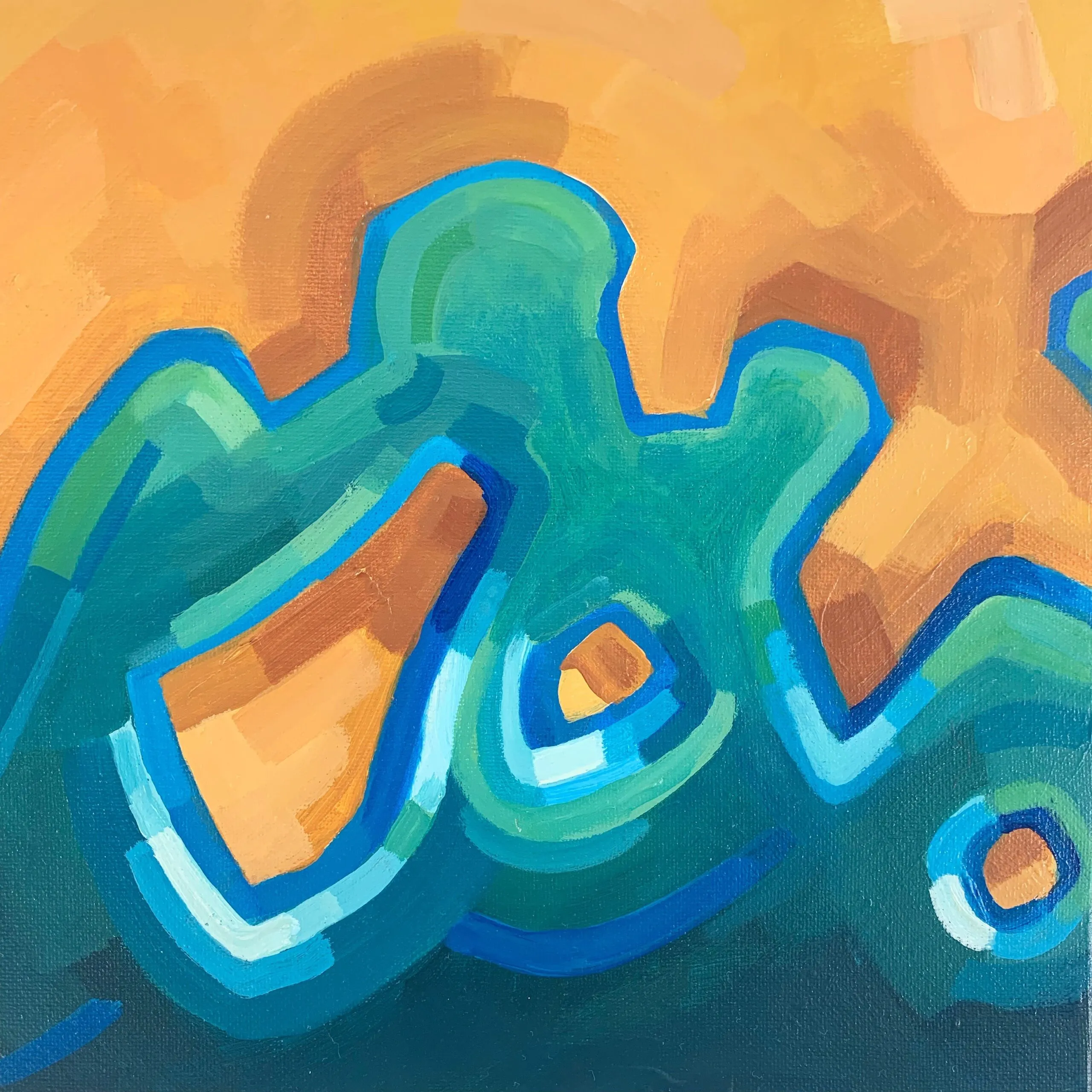
Twenty years ago, I was drawn to create different kinds of maps than the ones I typically encountered as a student of geography and cartography. I wanted to create visual geographic expressions that melded sense of place with sense of planet—since they are, of course, inseparable.
While conventional cartography has the tendency to subdue the dynamism of places—using muted tones, discrete categorization, and one precise scale—I seek to imbue my work with the shifting, colorful, indiscrete forces in the world around us. I want to make maps that say: Look at this remarkable situation, look at how it is continually changing, a constant and frenzied and miraculous interplay of water and mineral, life and death, light and air.
I offer my artwork of the Maine coast as an honoring of those intimate places that connect us to the larger, sacred whole.
Molly Holmberg Brown is a visual artist and map-maker. At her business MollyMaps, she runs map-making programs and creates custom maps for individuals and organizations. She discovered geography at Middlebury College, received a Watson Fellowship, and earned a Ph.D. in geography.
Keep the Coast Free
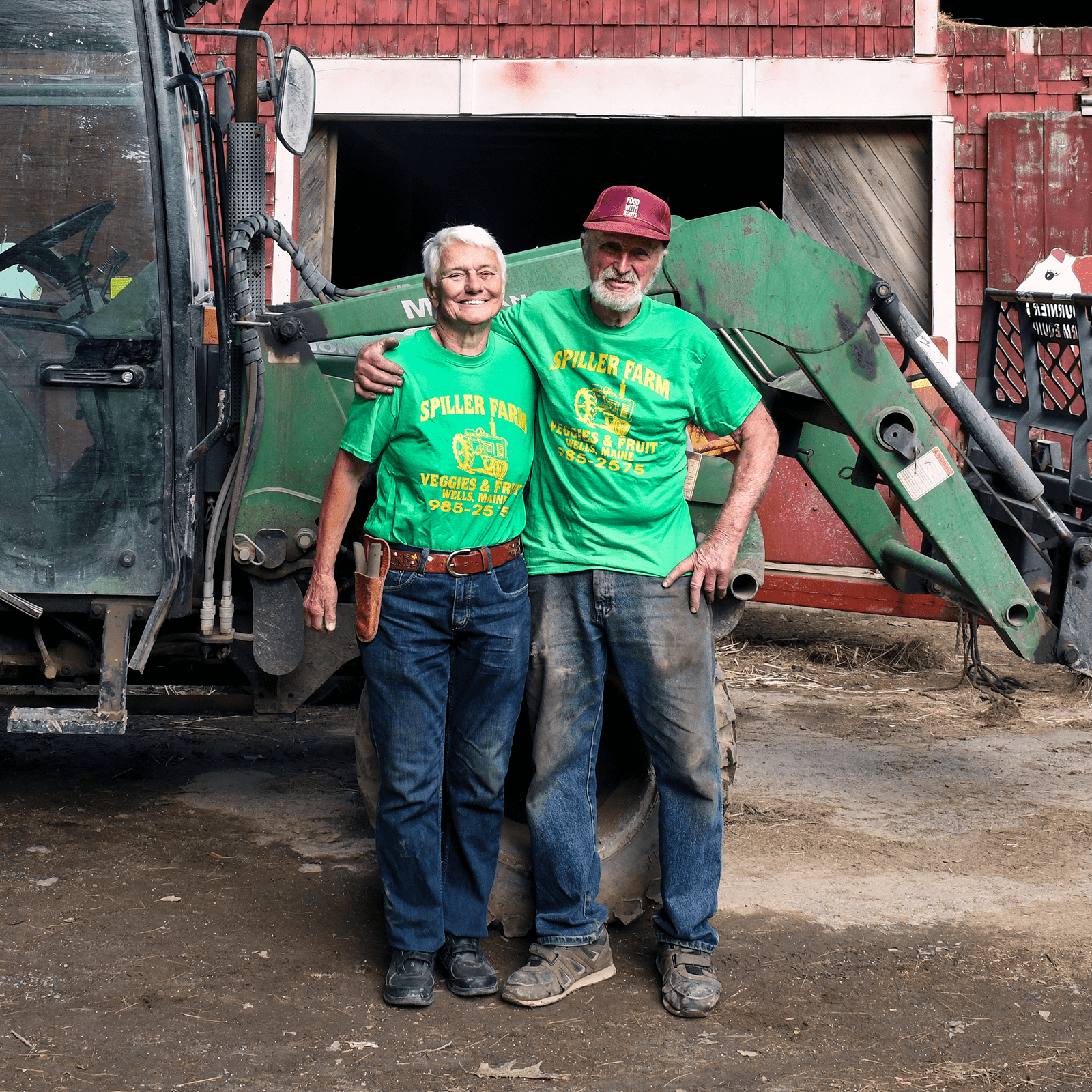
Photo by Courtney Mooney
“Wells is so developed now. It’s so changed from what it used to be. You used to go toward the beach and it was all open fields right to the marsh. You could look right out to the ocean. It was beautiful.
“In 2016, we placed the farm under a conservation easement, so it won’t be developed. We’ve seen so much development around here. We think that we need some farmland in the town to make the towns more diversified, make sure it doesn’t become just a bedroom community.
“I love seeing things grow, and having people come by the farm.”
—Bill Spiller
I like waiting on the U Pick customers. They come because they want the open land, that I love too. They like to be picking and listening to the birds singing.
—Anna Spiller
Anna & Bill have owned and operated Spiller Farm for over 50 years. Bill’s family has been farming in Wells since 1894, and Anna comes from a long line of farmers and loggers in the area. They worked with Maine Coast Heritage Trust and Great Works Regional Land Trust to put an easement on their farm and ensure the land will remain open and working in the decades to come. GWRLT now holds the conservation easement on the property.