On Beauty
Voices from the Coast: On Beauty
In celebration of Maine Coast Heritage’s 50th year, people share their visions of and for the Maine coast.
beau·ty /ˈbyo͞odē/ 1. a combination of qualities, such as shape, color, or form, that pleases the aesthetic senses, especially the sight.
Where the Land Meets the Sea
By Megan Grumbling
Video produced by Mark Ireland, M.I. Media, 2019
I grew up learning how to canoe down tidal rivers, how to dive under a wave, how to reach into tide pools to find moon snails I could put my lips to and hum.
I grew up learning how to be in the world by watching where and how the land meets the sea, by watching the complex ebbs and flows, crashes and shifts that happen only at the coast.
I grew up finding at the coast words that I wanted to hold in my mouth. Rose hip, and barnacle, and heron. I grew up finding in the coast a beauty that I wanted to learn how to speak and how to share. And so it’s no exaggeration to say that as a poet, the coast gave me both words and a reason to use them.
Now that I’m grown, living and writing and teaching in Portland, I still find new delight, wonder, and pleasure in our coast every day that I’m alive here. And I’m sure that’s the same for all of us.
Perhaps, like me, you find delight in the sudden white of an egret in a green marsh, or in the warmth of granite beneath you as you watch the shifting blues of sea and sky, or in the tart orange sweetness of a rose hip.
Perhaps, like me, you find delight in the sudden white of an egret in a green marsh, or in the warmth of granite beneath you as you watch the shifting blues of sea and sky, or in the tart orange sweetness of a rose hip.
Perhaps, like me, you’ve found wonder immersing in the froth and roar of a crashing wave, or hiking along a river under cool spruce, or swimming through eel weed in the dark amidst a twinkling green cosmos of phosphorescence.
Perhaps, like me, one of your favorite pleasures is the luxury of a high tide in late afternoon, as the light deepens like honey.
And perhaps, like me, you feel that the salt of our coast is alive in your very cells—that you belong to it.
And it’s not only pleasure that we find at the coast. I imagine that you too, like me, might come to the coast for renewal. You, too, might find solace and balance in the turning of the tides, or curiosity at the strange, intricate innards of a jellyfish, or endurance in how an eastern cedar gnarls against a sea wind.
When you spend time here, where the land meets the sea, you too might remember how liminal our own lives are, how fluid and how interconnected. And perhaps, like me, you come away from the coast feeling kinder, with a renewed desire to care for the people, creatures, and places around us.
I’m constantly gratified anew by how many of us do come together to do what needs to be done—the work of taking care—to make sure that all of us, and our children’s children’s children, will continue to find moon snails in tide pools, and to float in green coves, and to taste the glorious orange-red tang of rose hips.
We too are salt and water; we too have tides.
We have much to learn and to share here, where the land meets the sea.
Poet Megan Grumbling‘s collection Booker’s Point (2016) is a portrait-in-verse of an old Maine woodsman. Her forthcoming book Persephone in the Late Anthropocene, a sequel to the Persephone myth set in the age of climate change, is due out in 2020.
Video producer Mark Ireland‘s nearly 30 year experience in the industry includes 15 years at Maine Public Television where he produced numerous documentaries, including science programs for the Emmy award winning program, Quest.
Once More
by Holly Lombardo
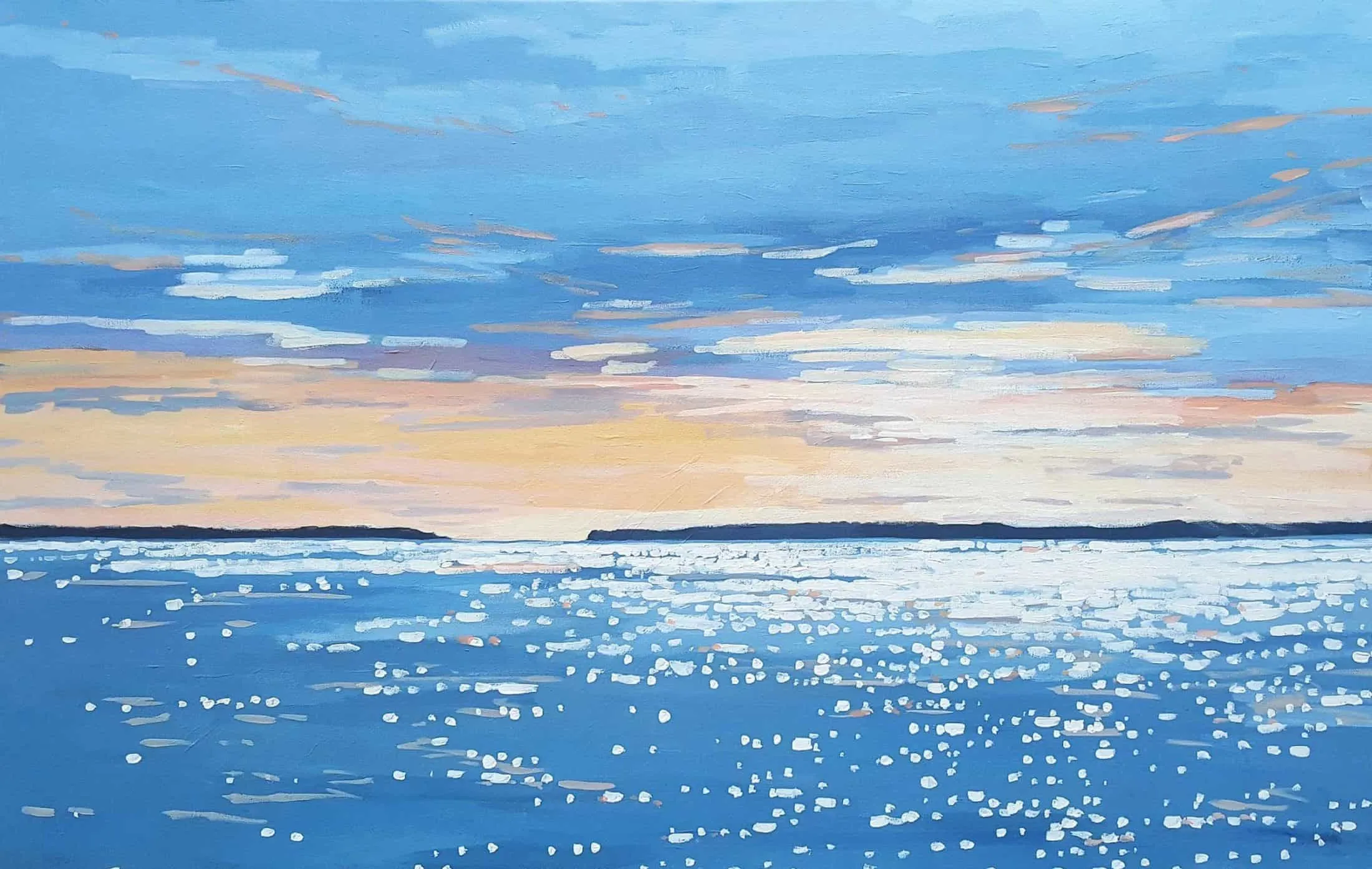
Holly Lombardo, Once More, 2018, acrylic on canvas, 30 x 48 inches
Holly Lombardo applies her science background to the proportions of her landscape paintings, and is always thinking about which colors to mix in her palette to achieve the vibrancy and detail characteristic of her work. She currently resides in Massachusetts and spends summers in Wells Beach.
Spring Tide
By Nancy Nielsen
When we came home, the sea said, “Wait.”
We waited.
That’s the way it is here;
sometimes the wind says, “Shiver,”
and we shiver;
sometimes I make a shopping list,
but if the snow says, “Stay,”
we clean the cupboard and make soup.
When we came home, and found the tide
over the road and into the alders,
I didn’t mind. The water rose quietly,
and when it ebbed and we passed,
we went quietly.
That’s the way it is here, sometimes,
and then we remember that it is no small
thing,
to live in a holy place.
Nancy L. Nielsen (1930-2016) was a poet, educator, and environmentalist whose poems reflect her deep love of nature and Downeast Maine. She co-founded the Quoddy Regional Land Trust (now Downeast Coastal Conservancy) and played a key role in many land protection projects in the Cobscook Bay region.
“Spring Tide” used by permission, estate of Nancy L. Nielsen
Sunrise
By Howie Motenko
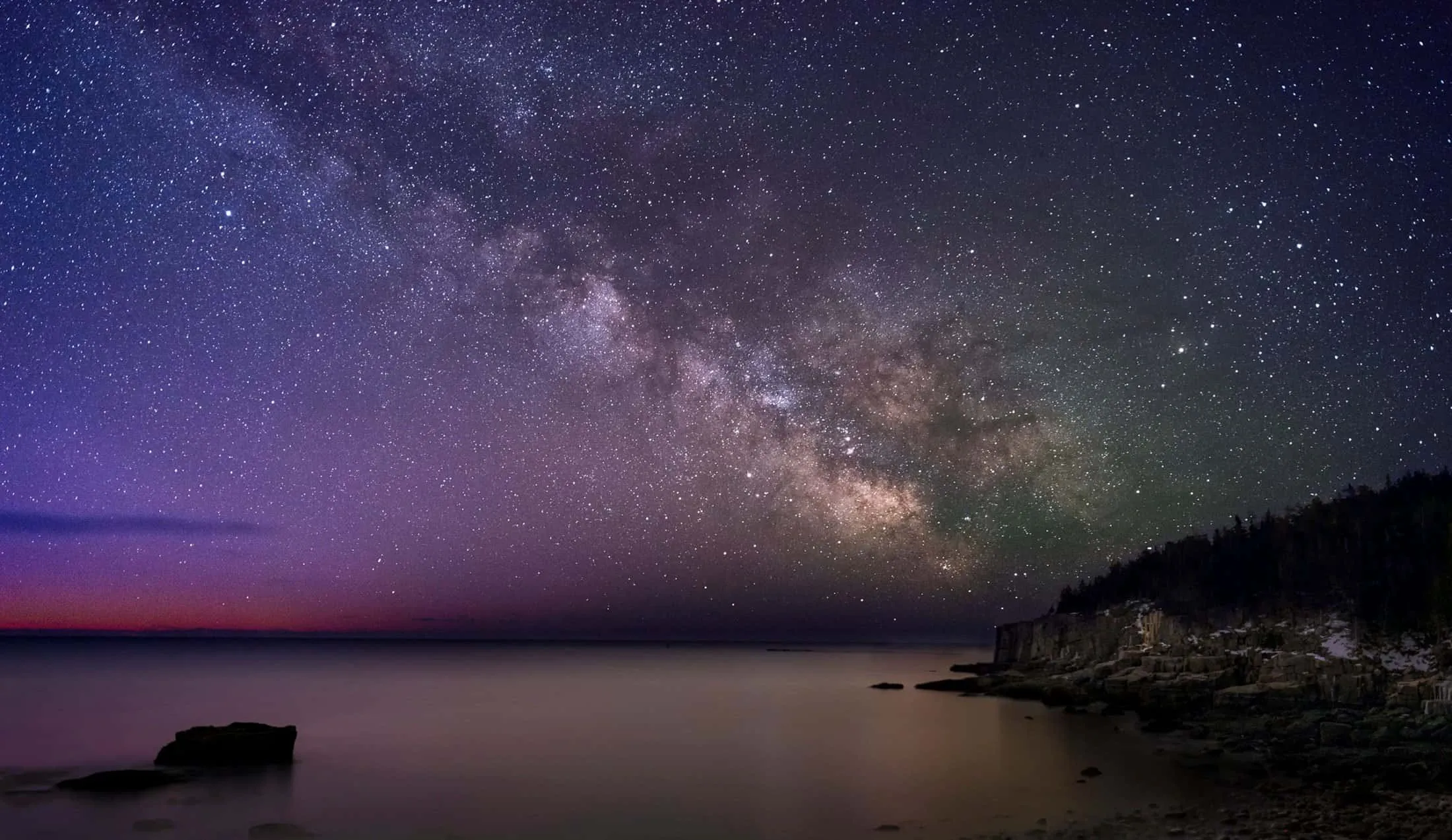
Howie Motenko, Sunrise, Acadia National Park, March 29, 2019, at approximately 4:30 a.m.
Landscape photographer and 2019 Acadia National Park Artist in Residence Howie Motenko lives in Maine, drawing continuous inspiration from the Park, literally in his backyard. Howie has led two community collaborative projects: Painting Islands and Painting Bridges, and leads photography tours and workshops through his business, Acadia Photo Safari.
Eli’s Creek
By Sue Charles
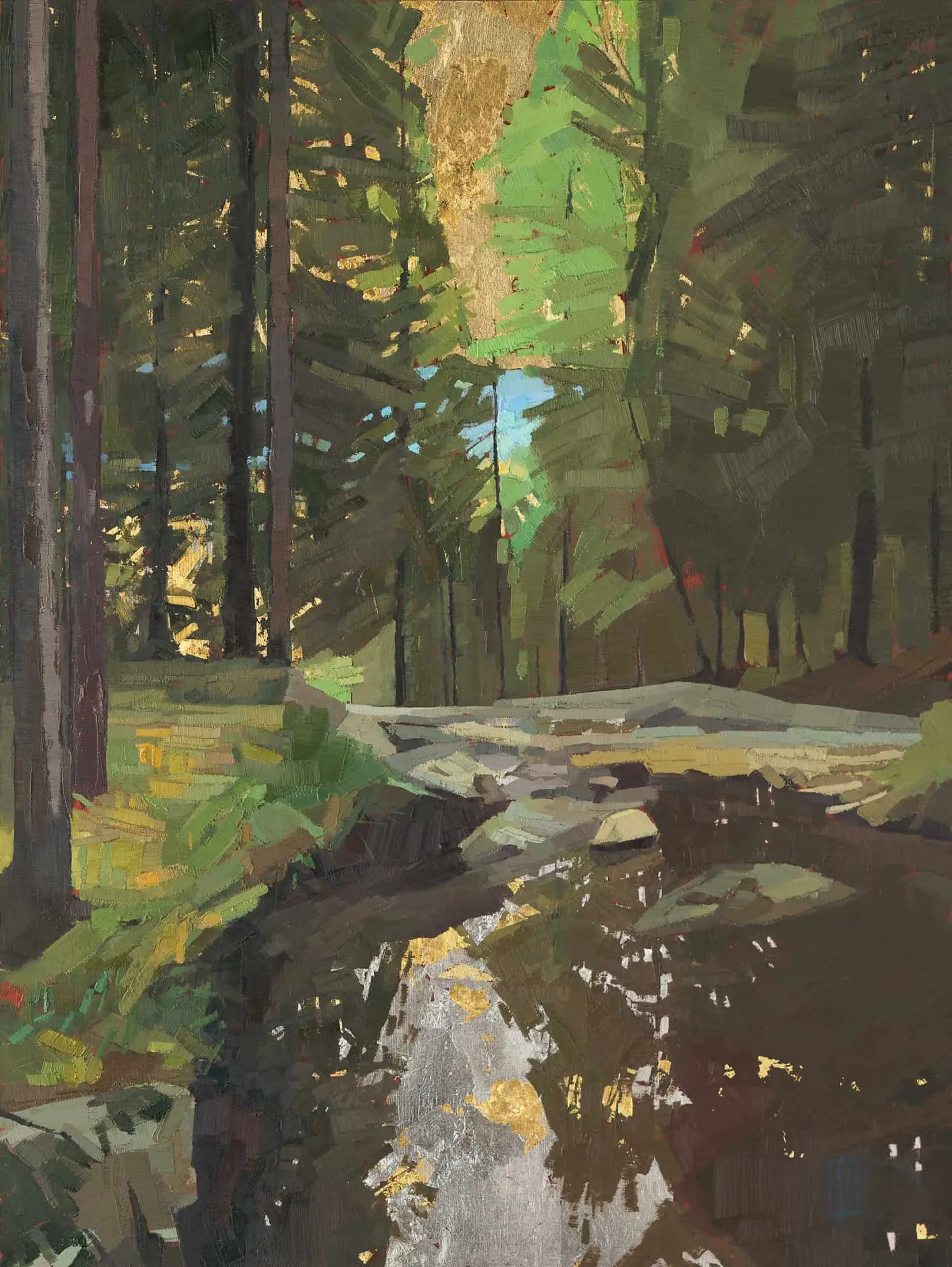
Sue Charles, Eli’s Creek, Mount Desert Island, 2019, oil, 23k gold and palladium gold on cradles wood panel
Sue Charles paints the New England landscapes where she experiences the most powerful connections with the natural world. She holds a BFA from Boston University’s College of Fine Arts, and shows in galleries in Maine, New Hampshire, and Massachusetts. A 2018 Acadia National Park artist in residence, Sue summers in Lamoine.
End of Land, Deer Isle
By Samaa Abdurraqib
If you travel over Eggemoggin Reach
– using the suspension bridge –
it will feel as if you will crash into the ground
on the other side.
You will not.
You will land safely
on this island of two parts
and you will see the ocean as you perhaps have dreamt it.
But you’ll have to bottle that up for now.
You have to keep driving.
This is not your destination.
You will miss the ocean as you travel further into this two-part island,
but you will turn right from Route 15
onto Main Street before it becomes Bridge Street before it splits the harbor in two.
You will not see this splitting.
You will stop for coffee
at the top of this street
and you will smell the ocean in a way you never expected.
The coffee shop is small and loved.
You will speak casually with the owner.
You will say names that make her face smile.
Everybody here knows those names. Everybody here knows that place.
Climbing back into your car,
you will find your way back to Route 15
and your chest will fill with an eagerness.
Deep into this two-part island, roads that should not be roads are roads,
But you will maneuver your car down the Fire Road
green of the cove on your right, rocks and dirt under your tires.
Eventually, you will come to the end…
You will park your car. You will drag out your chair –
legs scraping ocean rocks – right up to land’s end.
And you will be alone.
Let your body rest.
Watch the tide come in.
Watch the osprey circle.
Watch the stillness become darkness.
Watch the stars become the Milky Way.
Watch the tide go out.
Samaa Abdurraqib was raised in the Land of Buckeyes (Ohio), spent eight years in the Land of Dairy (Wisconsin), and moved to the Land of Lobsters in August 2010. She spent three years teaching Gender & Women’s Studies at Bowdoin College and transitioned into the non-profit world in 2013.
Twilight Across the Pool
by Nina Jerome
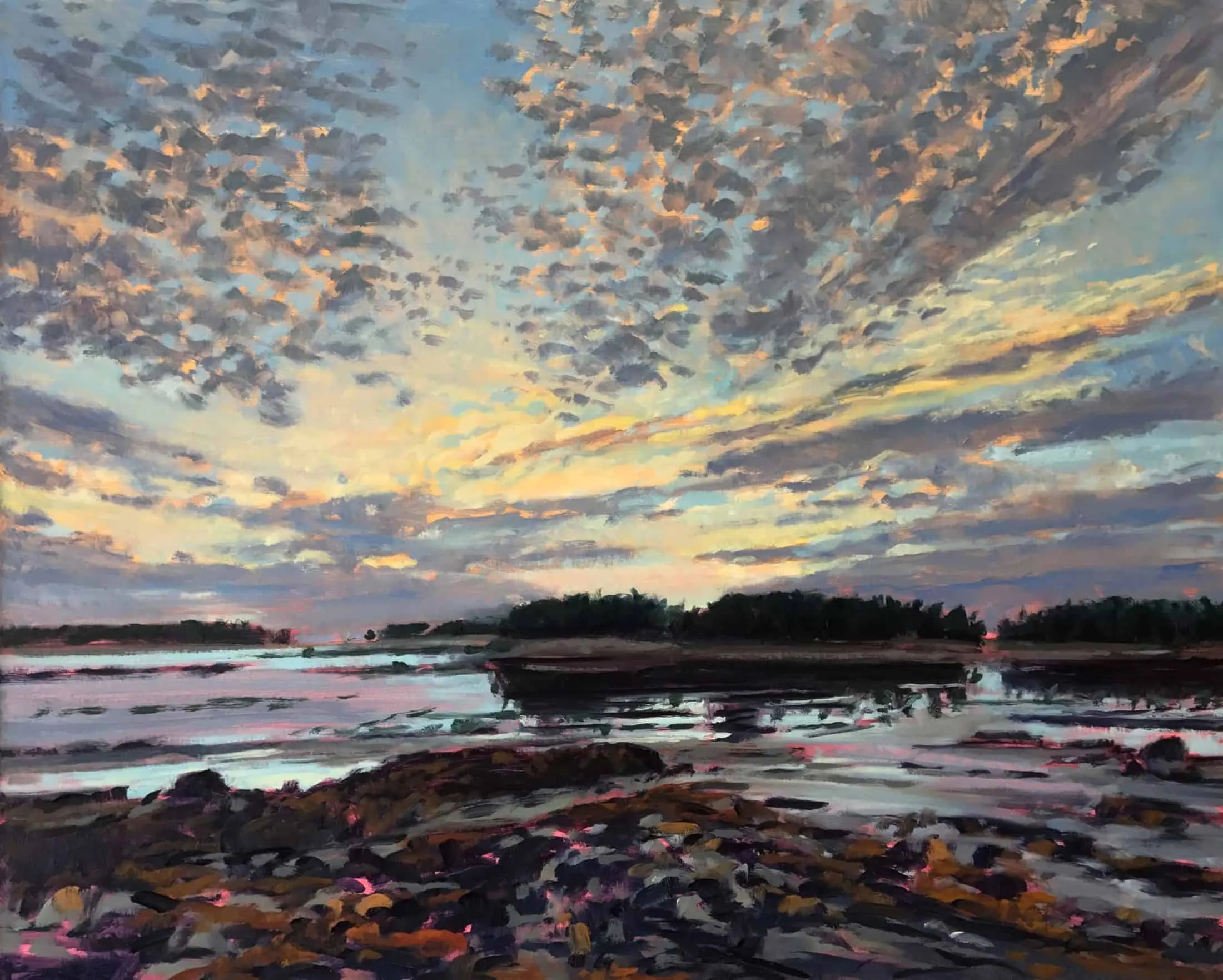
Nina Jerome, Twilight Across the Pool, 2016, oil on linen, 24 x 30 inches
Nina Jerome has lived in Maine since 1975 and paints the land that has been part of her experience along the way. She taught for 40 years and now enjoys painting full time, finding inspiration in both natural and constructed environments while at home or away.
From an Offshore Island (September Gale)
By Abbie Huston Evans
Hear now the ocean trouncing off this island,
The under-roar of wind down unfenced sea,
And through chance flaws, like dim light down a tunnel,
The bell buoy spent with distance.
Orion’s chill, washed, subterranean glitter
Wheels up from under, and great Rigel blazes
Between tossed oak boughs that the gale of autumn
Tears at, lifts, lets fall.
Old ocean’s hoarse and implicated roaring
Brings me up sitting at the dead of night,
Its pent-in mouthless fury calling back
The wild first of creation,
The rage, the might, the rampage.
—How shall I
Up from this anchored island not make answer,
I with my bones of rock-dust hardly knitted
And my blood still salt from the sea?
“From an Offshore Island” from Collected Poems by Abbie Huston Evans, © 1950, 1952, 1953, 1956, 1960, 1961, 1966, 1970. Reprinted by permission of the University of Pittsburgh Press.
Abbie Huston Evans was a teacher, social worker, and poet born in Lee, New Hampshire in 1881. She spent much of her youth in Maine, and returned to the state frequently throughout her life; the Maine coastline formed the principal subject of her poetry.
Shimmering
by Lindsay Hopkins-Weld
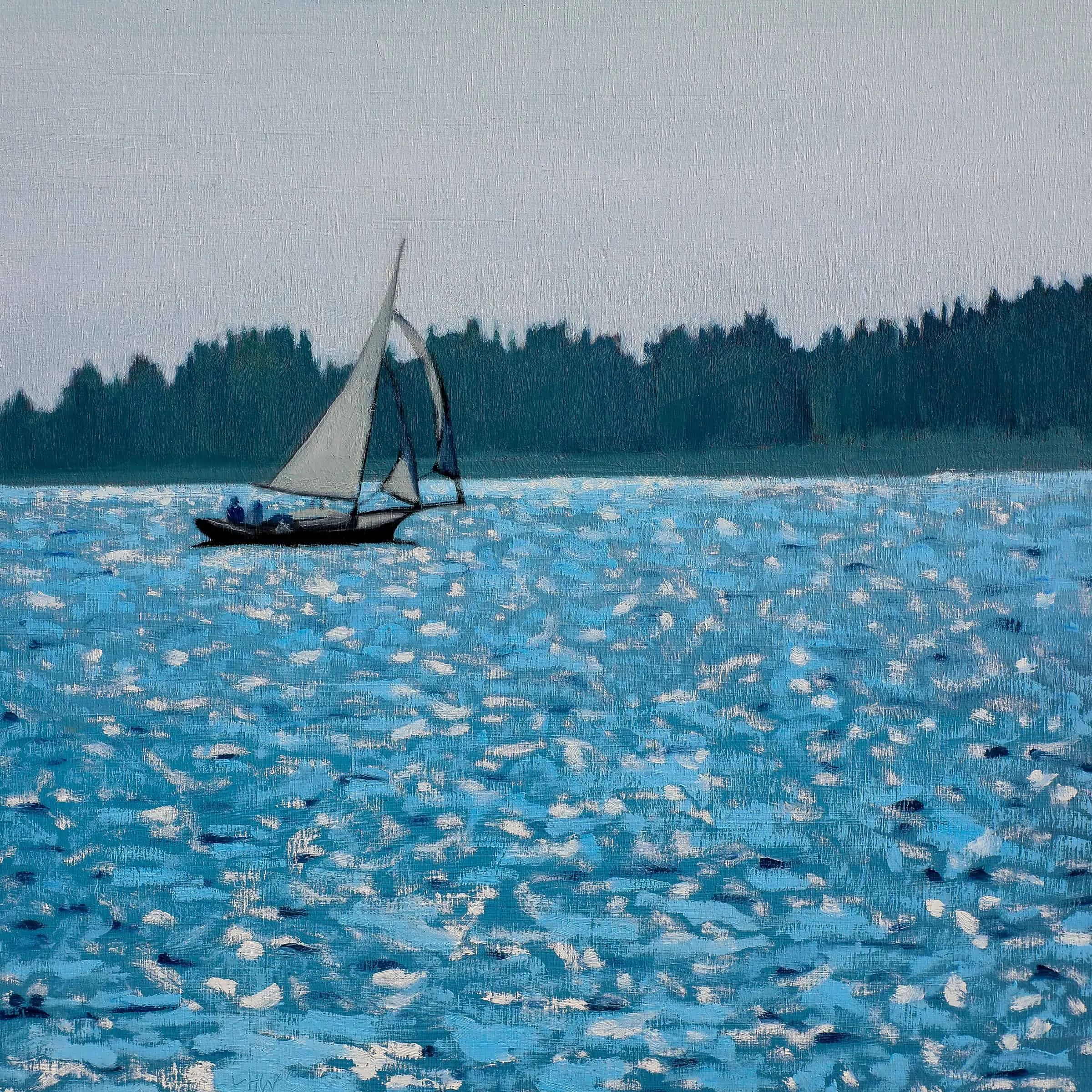
Lindsay Hopkins-Weld, Shimmering, 2019, oil on birch panel, 12 x 12 inches
Lindsay Hopkins-Weld lives in Scarborough, ME and spends as much time as she can on MDI. Most of her imagery comes from hiking the mountains, being out on the water and exploring the various islands that dot the coast. She strives to capture the fleeting beauty, soul and vibrancy of these places.