
The Ongoing Story of Babson Creek Preserve
A Small Place with a Pivotal Role
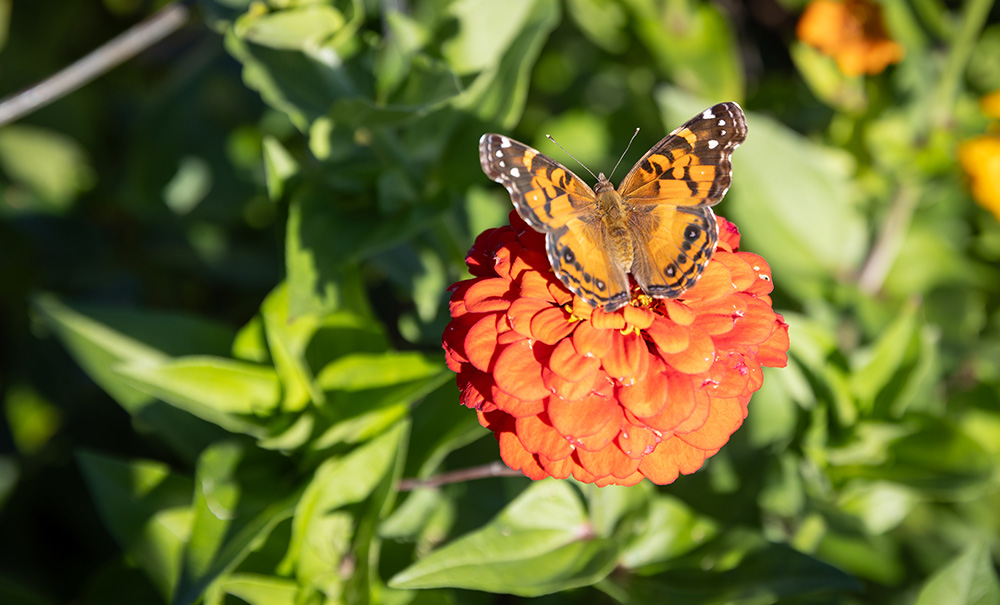
This 36-acre preserve on Mount Desert Island is a small but mighty sanctuary for a diverse array of wildlife. Brook trout, American eel, and stickleback wriggle against the current that flows through the creek. Great blue herons wade through the shallow waters, and spotted sandpipers, kingfishers, and hooded mergansers are just a few of the area’s frequent visitors. In the meadows beside the creek, one of the largest patches of milkweed on the island is a welcoming host for monarch butterflies, along with numerous species of bees and insects. Bald eagles soar across the open fields, perching atop tall white pines as they scan the creek, their white heads lit by the sun. As evening falls, great-horned owls reveal their presence with deep, rhythmic hoots. White-tailed deer traipse through the forested areas surrounding the creek, as do red fox, coyote, mink, and raccoons.
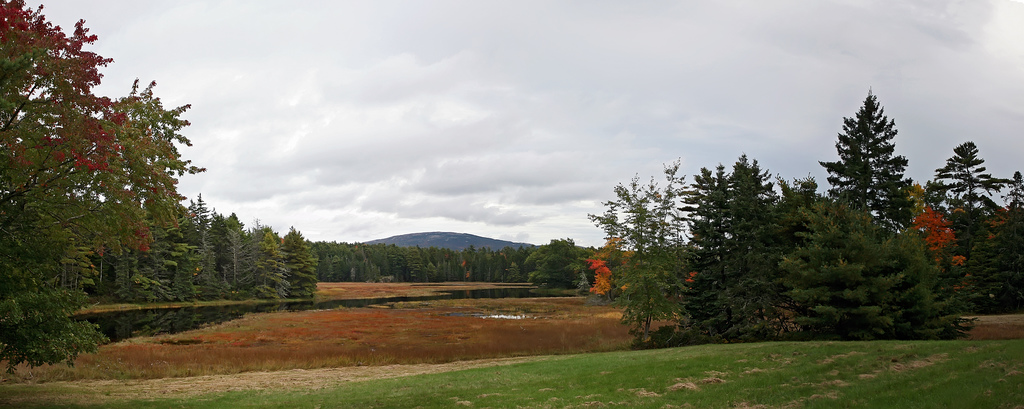
On Mount Desert Island, just upstream from Somes Sound—the deep, glacier-carved waterway that divides Maine’s largest island—lies Babson Creek Preserve. Half-hidden behind rows of evergreens, a hurried passerby may not even realize it’s there. But for those who pause to venture along the meandering paths beside the creek, the landscape offers a sense of wonder and connection.
Babson Creek Preserve is also home to one of the most diverse salt marsh ecosystems on the island. The marsh provides critical wildlife habitat, stores carbon, filters nutrients and pollutants, and helps protect against floods and storm surges. Given the significance of this unique ecosystem, the marsh has long garnered the interest of a whole host of researchers—from climate scientists to ornithologists—in their quest to understand and predict the impacts of sea level rise and other environmental changes along Maine’s coastline.
Just across the creek, a granite boulder emerges from the marsh like a whale surfacing for a breath. Notebooks in hand, students from a nearby elementary and middle school survey the landscape to note the vegetation and wildlife, recording evidence of the changing seasons. In the winter, students take to the marsh to “boot skate” across the frozen pools of milky saltwater, expertly gliding from hummock to hummock.
The creek is gleaming with light. I love how it fades from brown to green to blue to brown again. But it will never be the same – from where you look, to the tide, the weather…It is always moving.” –student from The Community School of Mount Desert Island
For Maine Coast Heritage Trust (MCHT), and our staff serving as the caretakers of this place, Babson Creek is an area with significant ecological and community value. The preserve is also home to our regional office on MDI, and the home base for stewardship operations.
From “Development Opportunity” to Protected Landscape
It wasn’t too long ago that MCHT’s connection to this special place first began.
In the summer of 2000, Darrold Dorr, a resident of Town Hill on Mount Desert Island, was scanning the auction pages of the local weekend papers when he came across an image of a familiar landscape. The photograph depicted a small creek meandering through an open marsh, flanked on either side by spruce and pine woodlands.
Babson Creek was a place Dorr knew well—a place he often visited to watch the birds catch fish, or to fish himself—sometimes alone, other times in the company of his family and friends. He considered the landscape to be one of the most tranquil places on the island. But according to the auction ad, the land represented something else entirely: “A Development Opportunity.”
In a Letter to the Editor of the Bar Harbor Tribune, entitled “Our Loss,” Dorr made the case for protecting the land, highlighting its scenic value and importance to the community. “Our island is shrinking at a rapid rate with more and more development projects,” he wrote. “Surely, there must be others who value this area as much as I and have the means to keep the Babson’s Creek area the way it is.”
As soon as the notice of the auction was posted, MCHT’s phones began ringing as community members shared their concerns about the future of the land. The Babson Creek parcels had drawn considerable interest from across the country, including among loggers and developers who were eager to bid on the 126 shorefront acres. By the time the listing went public, MCHT had just four weeks to strategize and secure the funding needed to acquire the property.
Shortly before the auction, several trust members stepped forward with an offer to front the funds—joining forces with MCHT to form “Maine Coast Partners.” After successfully purchasing the land, Maine Coast Partners donated 36 acres to MCHT—the portion of land deemed to have the highest ecological and community value—which soon after became known as Babson Creek Preserve.
On the northern edge of the preserve, just west of the creek, was the former homestead of Dr. Kendall Kittredge, a physician who first arrived in nearby Somesville in 1799. When MCHT acquired the property, the staff had hoped to restore the historic homestead to use as an office. Unfortunately, the building, which had been unoccupied for over a decade, had fallen into such a state of disrepair that its restoration wasn’t feasible. A new building was needed, but staff were committed to maintaining the scenic Babson Creek vista while also minimizing the organization’s footprint on the landscape. Considerable thought went into the building’s design and construction. It would be a single story, built near the road, with colors that minimize its appearance, prioritizing green architecture standards.
The office, which became one of the first LEED-certified buildings constructed on MDI, was completed in 2009. That same year, just across Route 102, MCHT also unveiled a newly constructed post-and-beam stewardship barn. The barn serves as the headquarters for the organization’s coastal stewardship operations in the region, housing a variety of equipment—from kayaks to lawn mowers to kiosk installation tools. It also serves as a meeting place for stewardship staff during the busy summer months.

While the Kittredge homestead provides a window into the past, the history of human presence on this land began long before the arrival European settlers. Maine is home to the ancestral and present-day homelands of the Wabanaki, or “People of the Dawnland,” which includes the Penobscot, Passamaquoddy, Maliseet, Mi’kmaq, and Abenaki tribes. The Wabanaki have lived in what is known today as Maine, New England, and the Canadian Maritimes for thousands of generations, and they have deep ties to Mount Desert Island. The island was seasonally occupied by Wabanaki people due in part to its abundance of natural resources. Game animals, birds, fish, fruit, nuts, and roots were plentiful throughout the freshwater, coastal woodland, and marine ecosystems on MDI. One coastal site long used by the Wabanaki for seasonal encampments was located at the entrance to Somes Sound, a short distance from what is now Babson Creek Preserve.
But the arrival of European colonists in the 17th century kicked off the long decline of many of the natural resources the Wabanaki relied on. From the coast up into the river valleys, settlers cut down trees to build homes and ships’ masts, or to use as firewood. They dammed rivers to power sawmills, blocking the passage of migratory fish from reaching their spawning grounds. Native people were dispossessed of the lands and waters they had relied on since time immemorial.
Agriculture was a major focus for settlers, and entire ecosystems were destroyed to make way for crops and pasture for livestock. Babson Creek was no exception. The salt marsh became the site of a salt hay farming operation. For hundreds of years, this colonial practice, which transformed marshes into productive agricultural fields, was used to produce crops for livestock and horses.
Today, lingering evidence of this farming practice can be seen in several stagnant pools of water along the marsh. These “mega pools” have gathered because of defunct drainage ditches and embankments that were once used to increase hay production. Unfortunately, they can alter the natural water flow and functions of the marsh, impairing its long-term survival.
Fostering Connections, Promoting Conservation
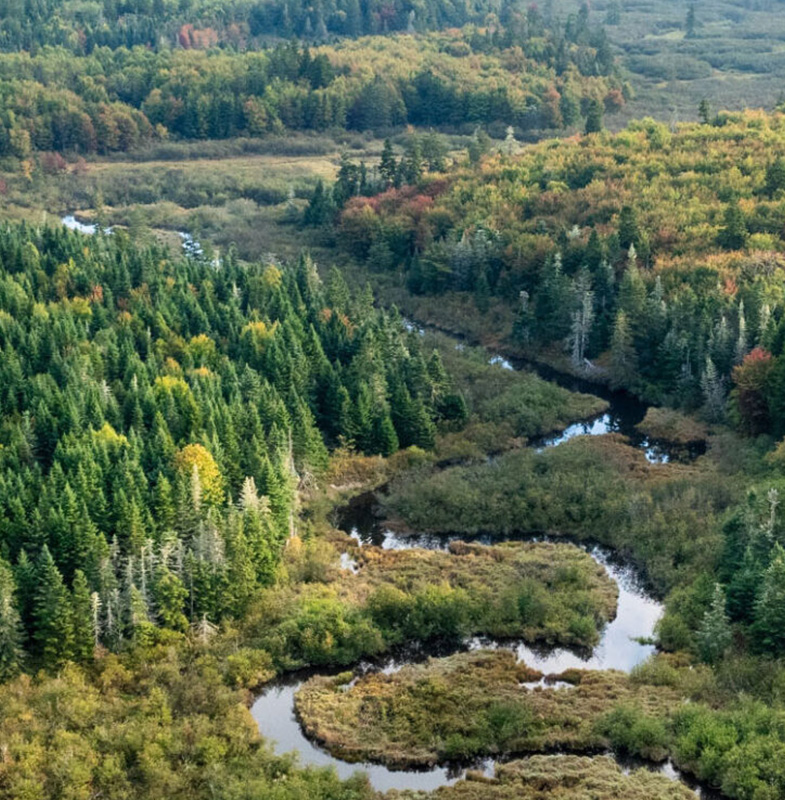
Less than two miles north of the preserve, a small beaver pond near Town Hill merges with Kittredge Brook to form the headwaters of Babson Creek. The tidal creek then flows through the open marsh and beneath Babson Bridge to form the gateway to Somes Sound and the Atlantic Ocean.
From the Babson Creek trailhead, a short, switchback path guides visitors past a stone picnic area and across a series of gently rolling fields to the creek. In the early mornings, enthusiastic birders are greeted by a diverse array of species. Red-breasted nuthatches, chickadees, bluejays, kestrels, woodpeckers, eastern phoebes, osprey, cedar waxwings, black-bellied plovers, and kingfishers are just some of the avian visitors that frequent the preserve. At other times of day, dog walkers and their canine companions stroll through the gently rolling fields that abut the marsh.
Across the road, adjacent to MCHT’s stewardship barn, is the Babson Creek Community Garden, a gathering place for local growers. Here, community members bend over garden plots as they plant, till, water, coax, and harvest their crops—tomatoes, herbs, Swiss chard, garlic, and potatoes, to name just a few. MCHT provides tools and equipment to support the roughly 20 gardeners who manage these plots. In October, gardeners gather alongside MCHT staff for a harvest picnic, a communal celebration of the season’s bounty.
The Babson Creek Community Garden has also played an important role in supporting “Kids Can Grow,” an educational opportunity facilitated by the University of Maine Cooperative Extension. In this program, gardeners between the ages of 7 and 15 build their knowledge and skills under the guidance of certified Master Gardeners. When the program isn’t running, the garden plots are used to grow food pantry items, such as beans, carrots, and squash, which are then donated to local food shelters.
In addition to the joy of being outside growing vegetables and flowers, the social benefits should not be overlooked…This garden project provides gardeners not only a beautiful place to garden, but also a place to rub shoulders with other people in our community. [It] is a real gift to us…” –Babson Creek Community Gardener
The preserve offers many other opportunities for learning and growth. Over the years, MCHT staff have led bird walks, as well as more formal education programs in partnership with nearby schools, such as MDI’s regional high school and the Acadia Institute of Oceanography. Teachers and students from the region have enjoyed the open access to these lands and waters, which can serve as an extension of their classrooms and a window into the natural world.
East of the preserve, across the creek, is the 70-acre Babson Creek Learning Forest, part of the broader Babson Creek watershed. In 2022, MCHT partnered with The Community School of Mount Desert Island (TCS)—a nearby independent, place-based elementary and middle school—to purchase the property from its previous owner. Today, MCHT holds a conservation easement on the land, protecting another critical habitat by limiting development in perpetuity.
In its teaching, the creek shows the students that this is not just a resource for us, but where other creatures come to water. In the morning, the ospreys are flying overhead and we’re watching them dive down to get fish. It’s fertile ground for animals to find food.” –Jasmine Smith, founding director, The Community School of Mount Desert Island
Babson Creek Preserve is just one small piece of a larger, connected landscape and wildlife corridor, but its unique salt marsh habitat provides important clues for scientists about the broader impacts of the climate crisis on coastal ecosystems throughout the region.
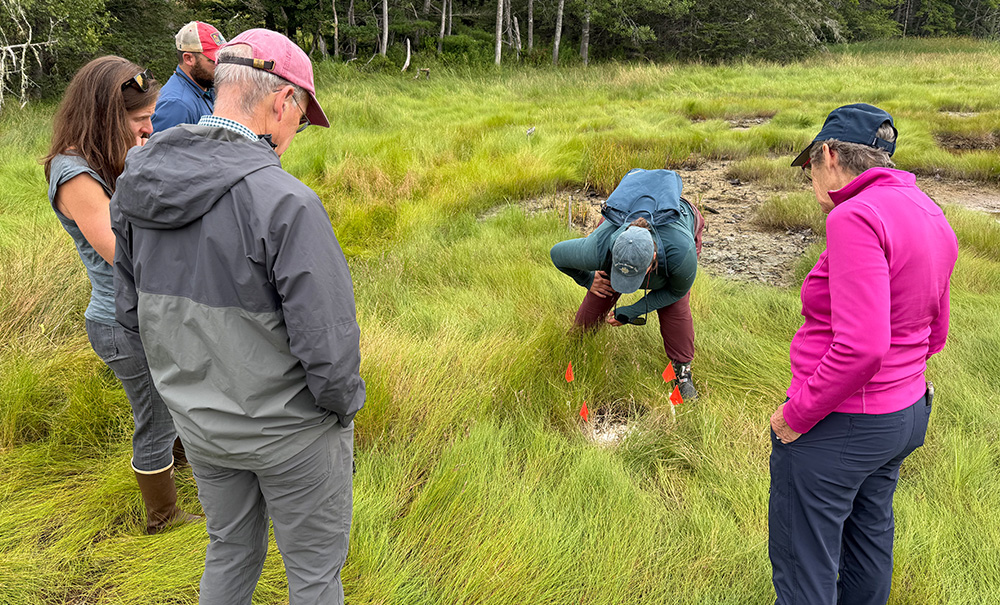
The preserve serves as a living laboratory for research teams. Scientists with the U.S. Geological Survey and the National Park Service have installed elevation reference bolts, along with barometric and water-level flood sensors, to monitor the impacts of sea level rise on the salt marsh. Ornithologists are studying the Nelson’s sharp-tailed sparrow, a species that nests in salt marshes and is considered highly vulnerable to sea level rise. The tidal marsh provides a nursery for marine species, and fisheries scientists are surveying silverside and mummichog fish, among other species. Other research teams are measuring salt marsh nutrient cycling and sediment accretion.
Looking to the Future
At the edge of an open field in the center of Babson Creek Preserve, two red maples lie side by side. Their trunks are angled against the earth, their wide canopies ablaze in autumnal reds. In January of 2024, back-to-back storms upended the adjacent trees, which toppled on either side of a picnic table overlooking the creek. By the fall, the trees were still alive but offered a visible reminder of the impacts of a changing climate on coastal regions.
For Tatia Bauer, MCHT’s Marsh Restoration Program Manager, the fallen trees offer a visible reminder of the importance of protecting this salt marsh ecosystem. “This is the area where we expect marsh migration to happen,” she said, gesturing toward the field. “A healthy marsh will support the migration into these non-developed spaces we’re working to conserve and keep as natural buffers.”
Salt marshes are some of the most important ecosystems that exist on our planet. MCHT is collaborating with partners across the state to conserve these critical habitats, including Babson Creek, and to restore their ecological functions. Restoring marshes is a multi-year process and in the early spring of 2026, the first major phase of restoration was completed on the Babson Creek Marshes, allowing us to begin the long-term monitoring and adaptive management phase of the project. Over the next 5-10 years, we will work to track changes in vegetation cover and composition, megapool size, and hydrology.
Babson Creek Preserve exemplifies the power of connection. The landscape shows us how one small place can connect entire ecosystems, and the many species, including humans, who rely on them.
Learn more about and support MCHT’s state-wide Marshes for Tomorrow Initiative.