
Part I: Laying the Groundwork for Assisted Species Migration—Helping the Trees of Tomorrow Take Root Today
In an open section of the Schoodic Forest in Winter Harbor, Maine, surrounded by birch thicket and balsam fir saplings, a tulip tree stands ten feet tall. Its namesake leaves, turning yellow in the waning daylight of fall, hang at jaunty angles, catching the sunlight. The stem is straight, the roots hold fast.
In late October, technicians with Schoodic Institute measured the tree’s height and growth and any signs of browse from snowshoe hare or deer. They made special note of the leaves. The end of the growing season in fall, along with its beginning in spring, are when a plant’s adaptive tendency is on display. The yellowing is a good sign that the tree is going dormant in time for the incoming winter season. Observations of the single tulip tree suggest this species, which currently grows only as far north as Connecticut and up the Hudson Valley, can grow quite well in the cool, moist Downeast coast of Maine.
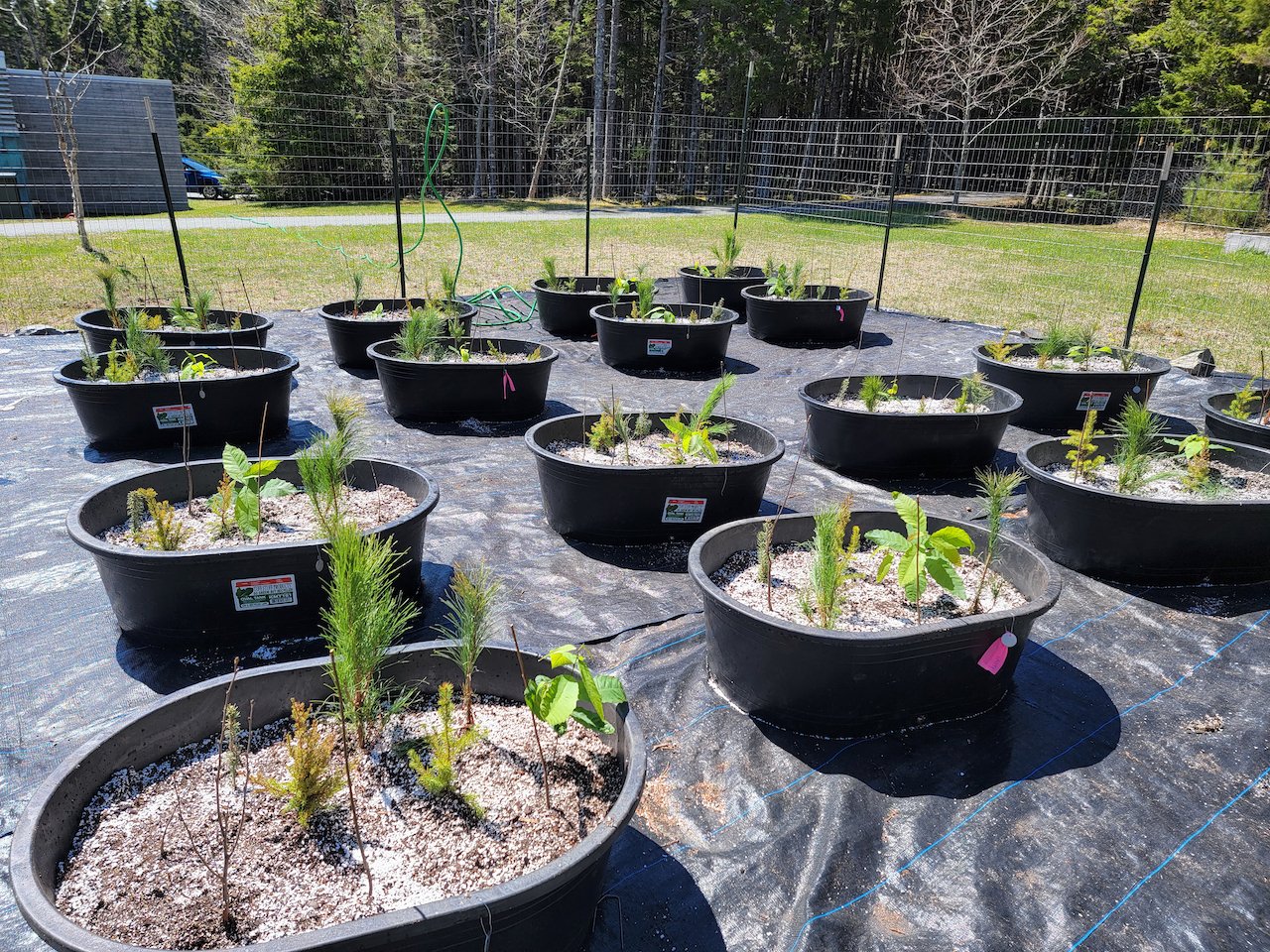
The tulip tree was one of eight species planted by Schoodic Institute scientists in 2019 as part of Future Forests of Coastal Maine, a research experiment at conservation areas between here and Belfast. Maine Coast Heritage Trust is a partner in the project, along with Blue Hill Heritage Trust, Coastal Mountains Land Trust, and Waldo County Soil & Water Conservation District.
Coastal Maine has its own unique climate, warmer and wetter than inland parts of the state where most forest research takes place. The Belfast-to-Schoodic region is also an area of transition, where many plant species near the northern edge of their range, and overlap with boreal species at the southern edge of their range.
As temperatures increase and precipitation patterns change, some plants may no longer be located in suitable habitat. It may get too hot, too wet, or too dry, or the plants may have to deal with unfamiliar insects and diseases.
For a plant population on the edge of its range to survive, it will need to adapt, drawing upon its own genetic diversity to adjust to the new climate. The alternative is to “migrate”—an individual tree may succumb to changing conditions, but a population can survive as seeds are dispersed by wind and animals. Plants have been shifting their ranges in response to climate for hundreds of millions of years, since well before humans came on the scene. But humans have made today’s situation very different from the past.
First and foremost is the speed of change. When climate was changing most rapidly in the past 20,000 years, species shifted their ranges at generally less than a quarter mile per year northward (an easy flight for the blue jay) or 30 feet upslope (an extended trek for a mouse). But the landscape is vastly different today. Recent rates of warming are within this range, but the landscape is vastly different. There is less available ground and more human-made barriers to seed dispersal. Warming is projected to exceed historical rates “in the foreseeable future,” according to researchers with the U.S. Forest Service. For many trees, their optimum habitat will move north by at least 60 miles.
Compared to when climate changed rapidly in the past, biodiversity in today’s ecosystems is depleted, limiting options for natural response. Diversity includes not just the different species present in an area, but also the genetic variation represented by those species, the DNA they draw upon to respond to stress.
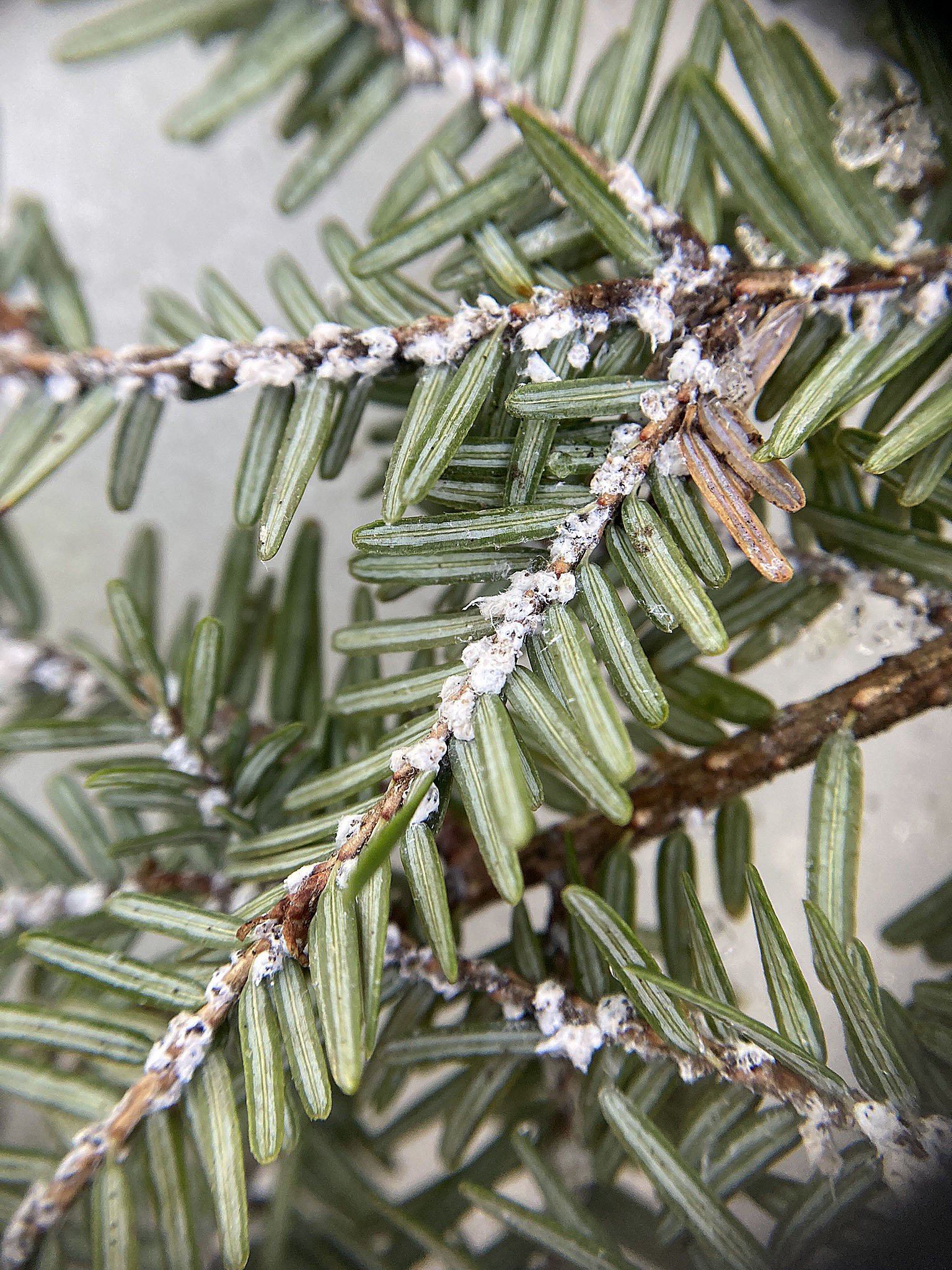
Climate change has also increased the frequency of disturbances such as storms, and expanded the ranges of damaging insects such as Southern Pine Beetle and Hemlock Woolly Adelgid. In fragmented forests, such disturbances create openings that tend to fill with an increasing array of invasive plants with the potential to shift forests to shrublands. Knowing which trees will grow well in the future forest will help managers be prepared to plant in the wake of disturbance and ensure continuity of forested ecosystems.
Forests are also much less connected. Even if a species could keep pace with the rate of change, and has the genetic flexibility to survive in novel habitat, it can’t necessarily get to that habitat because the landscape is too fragmented. Wind and squirrels can only carry seeds so far, which is partly why scientists have found little evidence that migration is currently taking place.
For all these reasons and more, some within the scientific and conservation communities have called for humans to lend a hand and assist plants by transplanting or relocating them to areas where the climate is expected to be more favorable in the future. A strategy called assisted migration.
This series will review what is meant by “assisted migration,” and why some feel it should be part of our response to a changing climate. We’ll visit gardens, greenhouses, preserves, and forests across the state where, as in Schoodic Forest, scientists and conservation organizations are experimenting with warm-adapted trees and shrubs from more southerly locales, and find out what they are learning. We’ll also take a critical perspective and consider the ethical, cultural, and ecological implications and questions that surround proposals to assist plants. Could we do it? Should we do it?
This is Part 1 of a series.
Click here to read all 5 installments in this series.
Catherine Schmitt is a science communication specialist with Schoodic Institute at Acadia National Park. She writes about research in Acadia and across the National Park System, and also provides communication training for conservation scientists and educators. She is the author of The President’s Salmon and other nonfiction books, editor of the Maine’s Climate Future series of reports (2009-2020), and contributing writer for Northern Woodlands and The Working Waterfront. Schmitt’s writing has been been published in numerous other magazines, newspapers, and literary journals. She previously directed communications for the Maine Sea Grant College Program at the University of Maine, where she also was an adjunct instructor in the English Department. Her writing is informed by her scientific background, which includes a master’s in ecology and environmental science and experience studying lakes, streams, wetlands, and beaches throughout the Northeast.