
Part 5: Trust the Trees
By Catherine Schmitt, Science Communication Specialist at Schoodic Institute
Great Pond Mountain Wildlands, Orland
In the Climate Resiliency Memorial Grove at the base of Great Pond Mountain, leaves are full and vibrant on the young trees: catalpa, bitternut hickory, shagbark hickory, black birch, white oak, black walnut, redbud, black tupelo, sassafrass, and, yes, tulip poplar. Wire fencing around the saplings has minimized (but not completely prevented) predation by deer; watering every four days has kept the grove “a haven of bright green life surrounded by a forest of struggling diseased beech,” said volunteer Jennifer Riefler.
Although they’ve been making energy from the sun for months, the unfamiliar leaf shapes are still a thing of wonder. Planting “new” species appeals to the innate human craving for diversity and novelty, while preserves like The Wildlands offer places to start conversations about whether and how to respond to a warming climate. While planting and watering trees, volunteers exchange stories about gardening and growing up, and gripe about ticks and the weather.
The success of these trees, and the hundreds of students and volunteers who have come out to help, are evidence that, yes, we can assist migration. People are ready to put their hands in the dirt. Some, like Penobscot Nation forester Ben Stevens, are drawing upon generations of ancestral knowledge, continuing a long legacy of sustaining forests. Others, guided by leaders like Aleta McKeage and Kathy Pollard, are forming new relationships.
Such new relationships are necessary if we are to have a forested future, said Amanda Devine, Maine Coast Heritage Trust’s senior director of stewardship. “We can’t just do conservation, we also have to restore functionality to degraded ecosystems,” she said, noting that assisted migration is necessary because warm-climate trees can’t get here on their own. And without action to manage invasive vines and shrubs, Devine fears the forest will become “an impenetrable wall of barberry.”
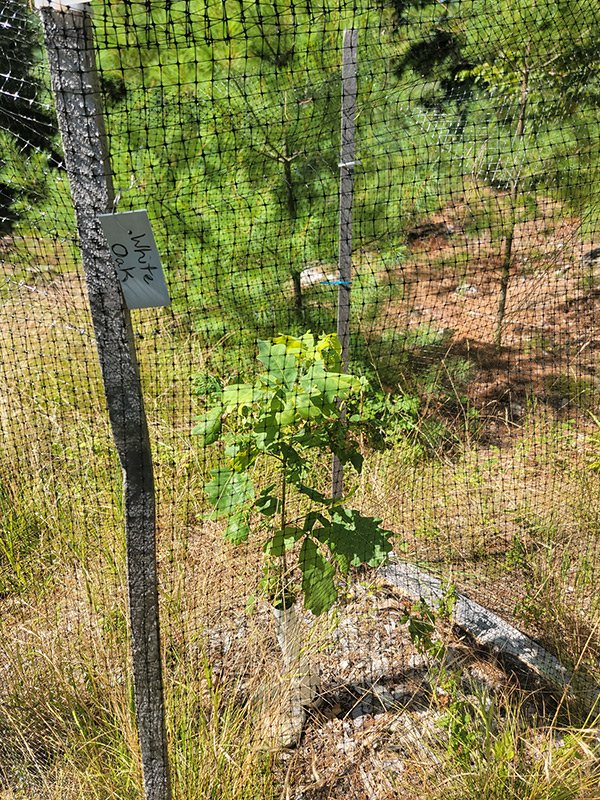
Experiments on land trust preserves have shown that we can plant “southern” trees and they will survive and grow in Maine’s varied climates. But there is much more that can be learned with a more coordinated, methodical approach that tracks tree survival and growth over time, according to Chris Nadeau of Schoodic Institute. “Moreover, a forest is about much more than tree survival and growth. We need to know that southern trees will support native insects, birds, and all other critters that depend on the forest before we employ assisted migration widely.”
Devine agrees. “I need data to inform how we manage extensive land areas.”
Consistent measurements were part of the design of the Common Campus experiment, with researchers from Schoodic Institute and the University of Maine planting the same species in similar settings at education campuses from Fort Kent to Saco.
The Ecology School, Saco
Only 150 miles from the wildlands of Hancock County, the woods of York County feel much farther away. There are tupelo trees at the beach, Atlantic white cedar in the heath, hickories along the river, and lots of white oak. Thomas Klak, recently retired after 38 years of teaching at University of New England, helped establish the Common Campus plot on the grounds of The Ecology School, the warmest location in the statewide experiment led by Jay Wason at the University of Maine.
Four years later, most of the trees are doing fine. Chestnut and white oaks are short, their foliage chewed and hole-ridden, but growing nonetheless. Red cedar, which shriveled up and died in the more northern plots, still has green branches. And the tulip trees are tall, their wide leaves splayed beneath a canopy of red and white oak. “At first, the growth was more equal among species,” said Klak. “Now, the broadleaf trees have grown more, especially chestnut oak.” The northernmost population of chestnut oak grows just a little bit south, on Mount Agamenticus. But the species also did well in the north.
Tucked in the woods, the plots are small and easily overlooked. It is hard to imagine such plantings, or even larger efforts like those on lands of the Penobscot Nation or Blue Hill Heritage Trust, transforming an entire forest. Researchers have estimated that, for assisted migration to effectively influence forest composition, planting would have to be repeated for multiple years and conducted on a very large scale, which is expensive. A lack of nursery capacity is also a challenge. All of the thousands of trees used in the projects profiled in this series came from distant nurseries, in Pennsylvania, Maryland, Michigan, and Oregon. Can we grow enough seedlings and saplings to counter the losses already occurring and those on the horizon? What are the consequences for genetic diversity?
Though the tulip trees are tall and seem like a good candidate for planting, Klak raised the point, learned from scientist and author Douglas Tallamy, that the oaks support hundreds more insects and birds. Just outside the fenced plot, a “wild” white oak, sprouted from an acorn from a mature tree nearby, had grown taller than the adjacent, planted white oak.
“It wasn’t this shady when we planted,” said Klak, noting the surrounding trees that created more of a canopy in the years since the project began.
Similarly, at the Great Pond Mountain grove, seedlings and saplings of red oak, white pine, and balsam fir grow in the spaces between the southern trees. How long before they, too, have overtopped the tulip trees?
Climate only partly explains why trees grow where they do. About half of tree species currently fill their modeled “suitable habitat.” Other factors, such as dispersal rates or presence of associated mycorrhizal fungi, may be a stronger influence on why a tree happens to grow in a particular location.
Surrounded by the fields of River Bend Farm, the Ecology School plot is at the edge of the woods next to a small overgrown clearing, an old road maybe, that hosts invasive bittersweet, barberry, and honeysuckle. But these plants were absent from the forest, a shady ravine of hemlock and silver maple, basswood and white oak, mature trees that “migrate” by sending their seeds into the wind, or relying upon birds, mammals, and even insects to disperse their seeds. Ants ferry seeds underground, rodents store samaras in mossy pockets, and blue jays carry acorns through the air. Left to its own devices, the forest wants to spread. The trees want to find new ground.
However, a changing climate is also facilitating northward migration of new invasive plants, which along with pressure from our existing invasive plants can prevent forest regeneration if not managed, said MCHT’s Devine. Maintaining healthy, functioning forests on preserves to the south is important to ensure they act as “stepping stones” for native trees to migrate to the larger, unfragmented northern forest. Individual land owners can also provide stepping stones. “Everywhere there is a gap in the canopy,” said Devine, “let’s plant something.”
Schoodic Peninsula
In the 1,700 acres of Schoodic Forest Preserve, the climate is cool and moist, worlds away from Saco Bay. Here grow jack pine and black crowberry, boreal species at the southern edge of their range. From here, it is possible to travel south 6 miles to the ocean at Schoodic Point, or north 20 miles to Schoodic Mountain and Donnell Pond Public Reserve Lands. Preserving this “Schoodic to Schoodic” wildlife corridor, one of the last of its kind on the East Coast, has long been a focus for Maine Coast Heritage Trust in collaboration with Acadia National Park, U.S. Fish and Wildlife Service, the State of Maine, The Nature Conservancy, Frenchman Bay Conservancy, and other partners. The more forest there is to the south, the less a forest is predicted to experience a change in composition. And larger forests have fewer of the edges where change is more likely to occur: migrating trees, but also browsing by deer, tunneling and jumping of non-native worms, and spreading of invasive plants.
Conservation preserves the greatest diversity of options for a forest to lead its own response to climate change, ensuring there is space and time for trees, plants, animals, and fungi to expand and contract their ranges, fragment into areas of refugia, coalesce into new communities. It also protects the many species that can’t move. By protecting and maintaining intact ecosystems that allow for these relationships, the few that are known and the many unknown, land trusts can assist migration without ever planting a single tree.
At Schoodic Point, there’s a slight gap in the canopy of red spruce and paper birch where a Common Campus plot is located on the Schoodic Institute campus. Most of the saplings have died, except for a white oak, black cherry, and tulip trees. The oak is stunted and malformed, the cherries chewed and spindly, but the tulip trees are tall and full, their wide, bright leaves contrasting with the dark, tight spires of spruce that form an uninterrupted skyline from here to Schoodic Mountain. Today these trees may be unfamiliar to one another, but their ancestors co-existed in forests of yesterday. They are trees, all of them, and trees are what we need if we want to have a forested future on the Maine coast. A little trust in the trees—and ourselves—goes a long way.
This is Part 5 of a series.
Click here to read all installments.
About the Author:
Catherine Schmitt is a science communication specialist with Schoodic Institute at Acadia National Park. She writes about research in Acadia and across the National Park System, and also provides communication training for conservation scientists and educators. She is the author of The President’s Salmon and other nonfiction books, editor of the Maine’s Climate Future series of reports (2009-2020), and contributing writer for Northern Woodlands and The Working Waterfront. Schmitt’s writing has been published in numerous other magazines, newspapers, and literary journals. She previously directed communications for the Maine Sea Grant College Program at the University of Maine, where she also was an adjunct instructor in the English Department. Her writing is informed by her scientific background, which includes a master’s in ecology and environmental science and experience studying lakes, streams, wetlands, and beaches throughout the Northeast.