
Part 3: Hands in the Dirt
By Catherine Schmitt, Science Communication Specialist at Schoodic Institute
Spring is an exciting time to be a tree. Conifers are increasing photosynthesis, pushing out tufts of new needles, while broadleaf trees are sending out delicate sprays and tiny fists of new foliage.
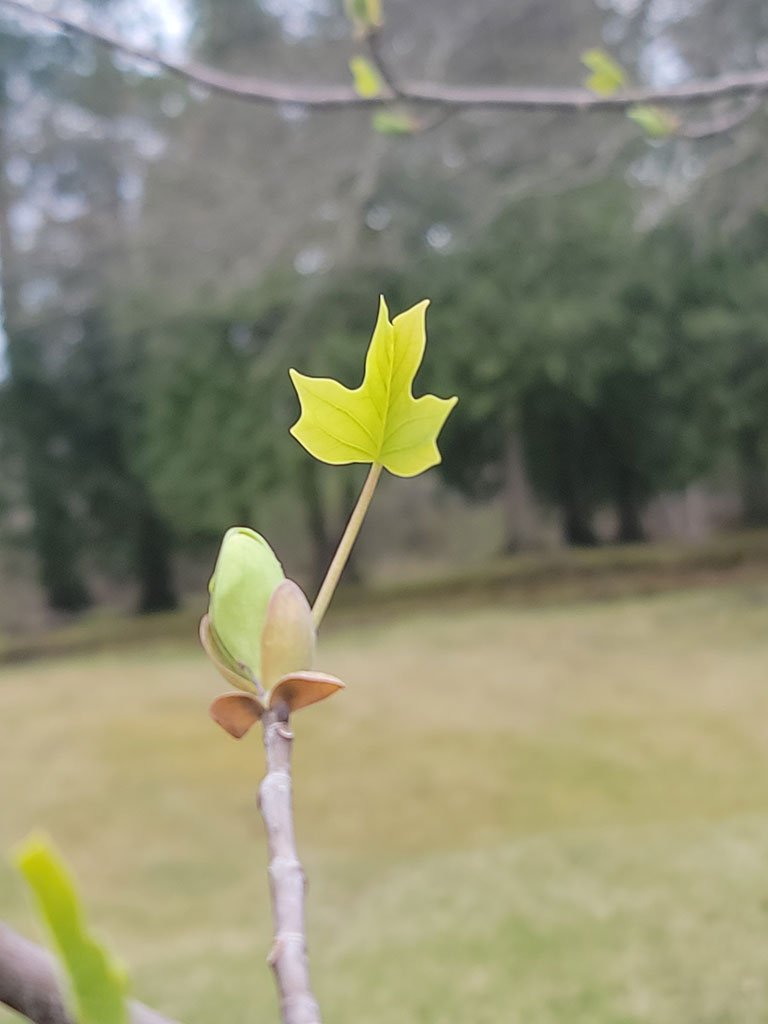
At the Maine Organic Farmers and Gardeners demonstration forest in Unity, maple leaves emerge crinkled and red. Birches drip with catkins and cherries hold finely serrated leaves up to the light. Oaks are still quiet, but tulip tree branches are tipped with lime-green leaves, still folded in half. The sweet-sweet-sweet of black and white warblers and the trills of chipping sparrows filter down from the canopy while ovenbirds call from the nearby woods.
“I think tulip trees want to be here,” said Aleta McKeage on a recent tour of the forest where the tulip trees, a tree more common to the south of Maine, grew alongside redbud and persimmon, hackberry and hickory, as well as shrubs like sassafras and ninebark. “People like these trees as ornamentals, and maybe eventually they become part of the ecosystem.”
Like many of her fellow tree lovers and forest ecologists, McKeage had become more and more worried about the future. Working at Waldo County Soil and Water Conservation District, teaching conservation landscaping courses, driving along the back roads of Maine in a pickup truck with license plates that read TRE HGR, she thought about climate change superimposed on stresses like beech bark disease, beech leaf disease, hemlock woolly adelgid, and emerald ash borer. Mentally subtracting tree species from the forest one by one, she began to anticipate a “forestocalypse.”

Assisted migration, she thought, was something people could do proactively to help the forest. The idea was still considered edgy, risky, in 2019, when she collaborated with Schoodic Institute’s Nick Fisichelli to initiate the Future Forests of Coastal Maine project.
She talked to people at Soil and Water Conservation District plant sales, about what trees and shrubs they were interested in, and why. She asked them to report back on the growth of many of the assisted migration study species. In 2021, with a Canopy Grant from the Maine Forest Service, she led an effort to enhance the City Park Arboretum in Belfast with new trees, including “climate appropriate adaptive species” like white oak and, of course, tulip poplar.
Perhaps because of the speed of climate change, or the mounting threats to Maine trees, or feelings of helplessness, or frustration with lack of leadership, or all of these things, desire to help forests migrate has increased in just the last six years.
Mousam Way Land Trust launched a project in 2021 to plant warm-adapted tree species on their reserves and also gave members and donors seedlings of red cedar, bitternut hickory, tulip, hackberry, and bald cypress.
The MOFGA Assisted Migration Plot started in 2023, also with support from a Canopy Grant. That same year, McKeage helped Viles Arboretum start their Forest of the Future Project: 120 tulip poplar, chinkapin oak, sweetgum and redbud trees, bolstered by the Maine Outdoor Heritage Fund. Oxford County Soil and Water Conservation District planted black walnuts in a portion of the Tenmile River Demonstration Forest.

This spring, Great Pond Mountain Conservation Trust is establishing a Climate Resiliency Memorial Grove and Blue Hill Heritage Trust has included bur oak among 1,900 trees being planted in Surry Forest.
Many of these plantings are in old fields or forests cleared by logging or removal of diseased trees, disturbed ground that often provides an advantage to invasive plants. At MOFGA, said McKeage, staff have to continually remove glossy buckthorn and multiflora rose. Maintenance is an issue at every site. Volunteers often help put trees in the ground (who doesn’t like planting trees?) but then there’s the ongoing watering, fence maintaining, and tree growth monitoring. At Viles Arboretum, some of the trees are missing their tags, their fencing falling over and crushed.
Required maintenance is one reason Mousam Way Land Trust did not protect newly planted trees with tubes, and now their project is “in shambles because of deer browsing, in spite of repellent spray,” according to volunteer Bud Johnston. “Then, meadow voles wiped out several hundred seedlings in our nursery that is located alongside a community garden. We did not use any rodenticide because gardeners walk their dogs outside of the garden. According to those who received tree seedlings and our own experience, the only species to survive to any extent are black walnut and red cedar. We have had better luck with planting of American chestnut trees on our holdings. A few of the hybridized strains have borne nuts.” At the Great Pond Mountain grove, deer knocked over fencing to get at the tender saplings.
These experiences are a reminder that the forest is more than trees. It is the deer and hare that nibble twigs and leaves, the small mammals and birds that distribute seeds, insects that pollinate and perforate. A forest is clean air and adequate water. A forest extends below the surface, to the teeming community in the soil. Trees are associated with different kinds of mycorrhizal fungi with different ways of cycling nutrients—scientists recommend selecting species that share fungal diversity with the planting site.
So what does it mean to plant tulip trees, with arbuscular mycorrhizae that live inside the roots, in a forest of white pine and oaks, which associate with ectomycorrhizal fungi that ensheath the outside of roots? The MOFGA plot may help answer this question, and at such a small scale in an area of already-disturbed ground, it may not make much difference ecologically.
Indeed, the multiple trials at land trust preserves and demonstration forests across Maine may be much more impactful psychologically.
Aleta McKeage describes her projects as “interpretive ecological restoration.” Labels on trees and explanatory signage prompt conversations about restoration and adaptation. It is a ground shift for conservation, which is rooted in protection and preservation, in leaving no trace. “The forests need us to get a little bolder,” said McKeage.
From Surry Forest to Great Pond Mountain Wildlands to Mousam Way, as people prepare the ground for planting and watch the growth of last year’s seedlings, they imagine into being a thriving, forested future. It is a kind of assisted migration of the mind, a coming to terms not just with the urgency of climate change and responsibility to respond, but also with other ways of relating to the land.
In this, there is much to learn from those who have known these woods forever.
This is Part 3 of a series.
Click here to read all 5 installments.
About the Author:
Catherine Schmitt is a science communication specialist with Schoodic Institute at Acadia National Park. She writes about research in Acadia and across the National Park System, and also provides communication training for conservation scientists and educators. She is the author of The President’s Salmon and other nonfiction books, editor of the Maine’s Climate Future series of reports (2009-2020), and contributing writer for Northern Woodlands and The Working Waterfront. Schmitt’s writing has been been published in numerous other magazines, newspapers, and literary journals. She previously directed communications for the Maine Sea Grant College Program at the University of Maine, where she also was an adjunct instructor in the English Department. Her writing is informed by her scientific background, which includes a master’s in ecology and environmental science and experience studying lakes, streams, wetlands, and beaches throughout the Northeast.