
Part 2: Testing the Edges
It’s that time of year. Across Maine, people are checking the marked pages in garden and nursery catalogs and placing their orders. Some may have already started seeds, in greenhouses and cold frames and sunny windowsills warmed by the lengthening days. This annual rite of spring involves making decisions about what to plant now, for harvest later.
Foresters in charge of growing trees for wood and other products make similar decisions, and one of their tools has long been the “Common Garden.” Seeds of trees from different locations are planted together in a randomized grid, and then evaluated to identify the fastest-growing or hardiest populations. Results inform guidelines for “safe” distances to transfer seeds. Seeds moved too far from their source population may grow poorly or not at all, and forest managers want to ensure they select trees that are adapted to local, current conditions.
But now, as warming has accelerated, forest managers are thinking more about future conditions and increasingly seeking seed from more southerly or warmer locales, according to Carolyn Pike, a forest regeneration specialist with the USDA Forest Service, presenting in a recent webinar.
Pike worked with a team to develop seed transfer guidelines for some eastern U.S. tree species, but information for many species is lacking. Historically, common gardens (also called provenance trials) tested seeds of pine, spruce, and other conifers most valuable to the forest products industry. A few trials included northern red oak, yellow birch, and sugar maple, but otherwise information about other hardwood trees and plants is sparse. Also, most common gardens have been located in the center of species ranges, where conditions are assumed to be optimal, not the edges, said Pike. “That’s where we need research.”
Maine has a lot of edge. The state sits within a broad transition zone, where many plant species reach the northern or southern edges of their range, where the oak-hickory forests of the temperate south meet the spruce and fir of the boreal north. There are edges of mountains, and thousands of miles of coastal edge.
Edges are where shifts in plant populations in response to climate will be most noticeable, according to forest ecologist Nick Fisichelli, Schoodic Institute president and lead investigator on the Future Forests of Coastal Maine project.
Working with partners from Maine Coast Heritage Trust, Blue Hill Heritage Trust, Coastal Mountains Land Trust, and Waldo County Soil & Water Conservation District, and with funding support from individual donors, Fisichelli located the Future Forests plots in clearings and at the fringes of existing woods—the sunlit, blank-slate spaces where, should new seeds arrive via wind or wildlife, they would have the best chance of survival compared to the shady, crowded middle of the woods.
It can be hard to think about seeds when the ground is still covered in snow and ice, but there are signs of spring amid the gray. In the Schoodic Forest Preserve, trees are absorbing enough of the sun’s heat to melt circles in the snow around their trunks. Alder and maple branches are reddening; the crusted snow is littered with spruce tips clipped by red squirrels.
Most of the preserve is birch and aspen, young forest that followed the last timber harvest about 25 years ago. Eventually, the forest will come to resemble the region’s more typical red spruce and balsam fir, trees that are fostered by cooling sea breezes and fog from the nearby ocean. Yet these species are also considered to be the most vulnerable to warming temperatures. Will the climate here still be suitable for spruce and fir in the future? If the current trees fail to regenerate, which species will take their place? What should we be planting now to ensure Schoodic Forest remains a thriving forest?
These are the questions the Future Forests of Coastal Maine study is designed to answer. The plots are about a mile down the old logging road that cuts through the middle of the preserve. The trees were planted as bare-root seedlings in the tradition of a Common Garden grid. Many have grown tall enough to stick up above the snow.
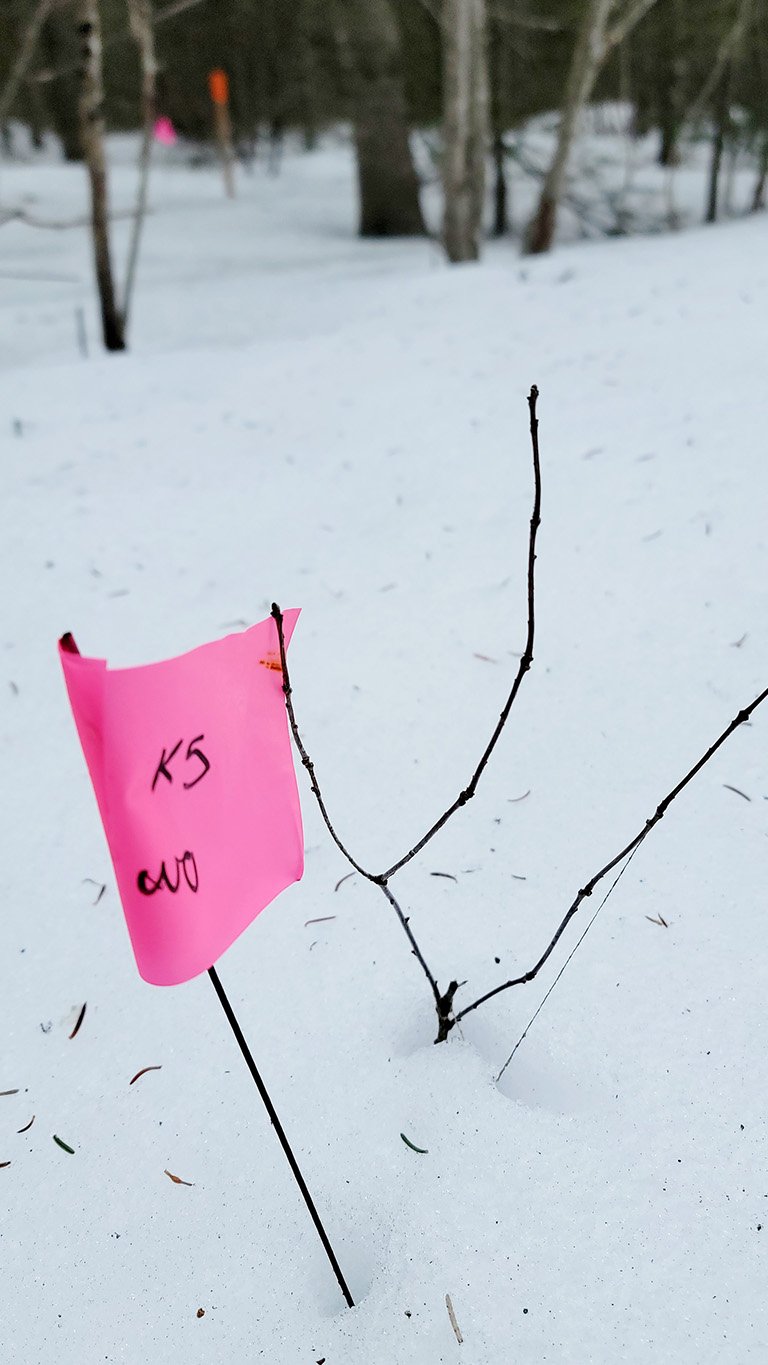
There’s that tall tulip tree, barely distinguishable from a winter backdrop of fir and birch. A short white oak has three branches to replace its terminal bud chewed by a snowshoe hare. A sweet gum, protected from browsing for several years, has reached sapling status and sprouted multiple new twigs. A chestnut oak is shorter, but looks sturdy and straight in its little snow hollow.
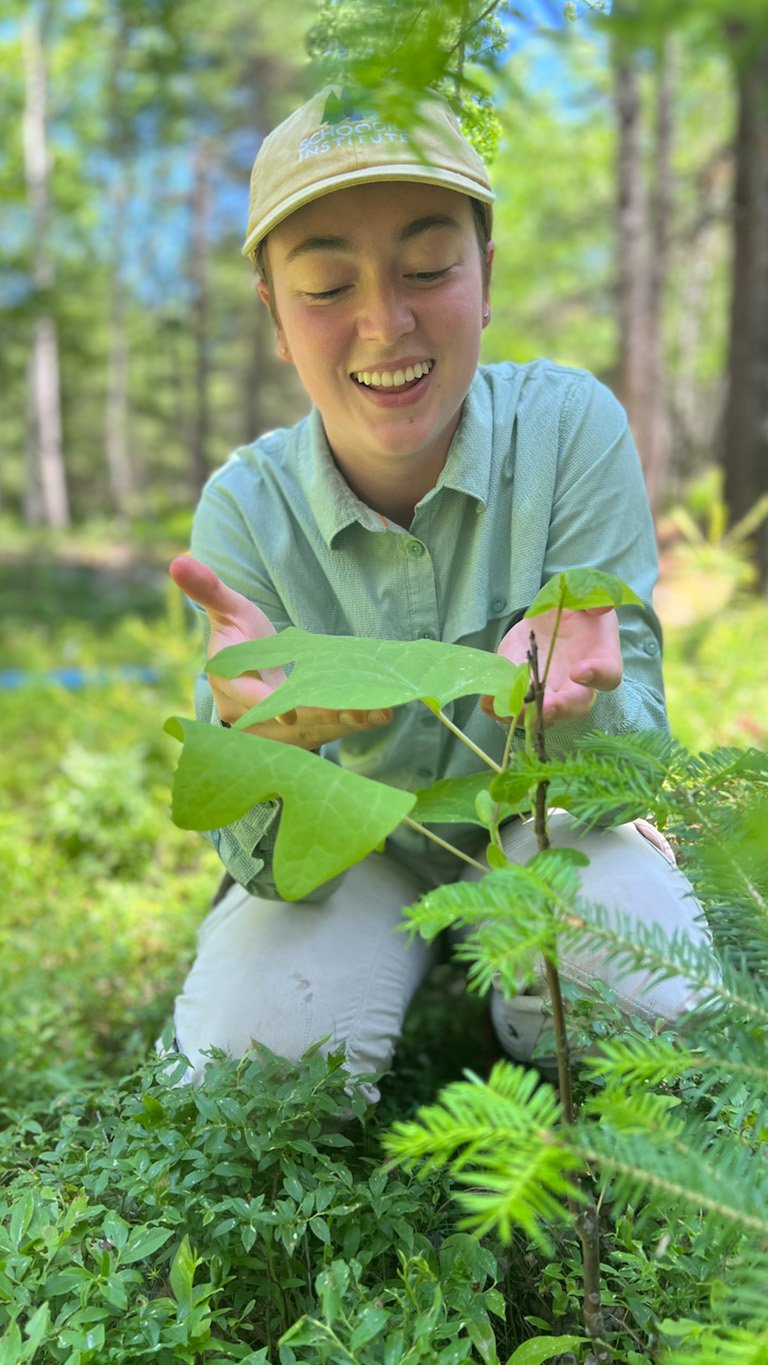
These warm-adapted or “southern” species, growing outside of their current ranges, make this experiment a test of assisted migration. There are different approaches to assisted migration. For the tulip tree and sweet gum, which currently grow only as far north as southern New England and New York, moving them far beyond their range boundaries to Downeast Maine would be assisted species migration. Moving species to new areas is the most drastic assisted migration strategy, sometimes framed as “rescue” when applied to threatened and endangered species, and often what people think of when they hear “assisted migration.” The chestnut oak’s range limit is a bit farther north, in York County, but still nearly 200 miles away, about the farthest distance seeds can be moved and still survive, according to conventional forestry guidelines.
Assisted migration can also take more subtle forms, including helping existing populations persist and spread within their current range, known as assisted population migration, as would be the case for the white pine and white spruce in the Future Forest plots. This can also be approached as assisted gene flow, if seeds from different populations are mixed. The white oak trees are an example of assisted range expansion, since their current limit lies relatively nearby, in Midcoast Maine.
Schoodic Forest is the coldest location in the study, one of four sites that span a gradient of climate, with Belfast as the warmest site. The project builds upon the Tree Test Bed Study, which from 2017-2019 monitored the growth of seedlings from 19 tree species across a similar climate gradient in Acadia National Park.
Due to its range in elevations, from sea level to over 1,500 feet on Cadillac Mountain, and coastal proximity, Acadia’s average annual temperature varies about 2.7 °F (1.5 °C) across the park. Temperature varies even more across seasons. In summer, temperatures in the interior of Mount Desert Island can be 10 °F warmer than shorelines cooled by southerly winds. In winter, the coastal sites are the warmest and the coldest site is the top of Cadillac Mountain.
“We use the warmer sites as proxies for what future conditions might be like at the cooler sites,” said Fisichelli. “The strong seasonal differences in climate also provide the opportunity to identify which seasons have the strongest impacts on species.”
At the low elevation areas away from the coast, hot dry summers parched the small seedlings and many stems died from drought stress. On the Schoodic Peninsula, moist and cool conditions encouraged high germination of all seeds. However, across the study sites, winter conditions caused many seedlings to die, especially southern species planted well beyond their range limits.
These results were enough for Fisichelli to want to learn more. Because the Tree Test Beds were in a national park, the seedlings had to be more tightly controlled, planted in raised beds, and not allowed to mature. Collaboration with Jay Wason, John Zhang, and Pratima Pahadi at the University of Maine led to the Common Campus study, a three-year Common Garden experiment at eight education campuses across Maine, and the Future Forests of Coastal Maine project.
For Future Forests, volunteers planted seedlings directly in the ground without any fencing around the plots, although some seedlings were sheathed with plastic tubes to protect them from browsing deer and snowshoe hare. For more than five years, their roots spread and mingled, their leaves felt the same sun and wind.
Of all the tree species in the experiment, which included local species like red oak, white pine, and white spruce, chestnut oak had the highest survival rate, more than sixty percent, across the study sites. Tulip tree had the lowest survival rate; those that did survive, however, grew well, as evidenced by the tree in Schoodic Forest. The trees are still young and results are preliminary, but suggest that we can help trees migrate from south to north.
Foresters and ecologists have been discussing and researching assisted migration since the early 1990s. Hundreds of studies have been conducted, and a recent review found that a majority (58 %) supported assisted migration, showing it could enhance adaptation to climate change, boost forest productivity, and preserve biodiversity. A third of studies were categorized as neutral, and 11 percent reported negative outcomes. These studies were in the context of managed forests. There are far fewer tests of assisted migration as a conservation strategy, according to a literature review by The Nature Conservancy.
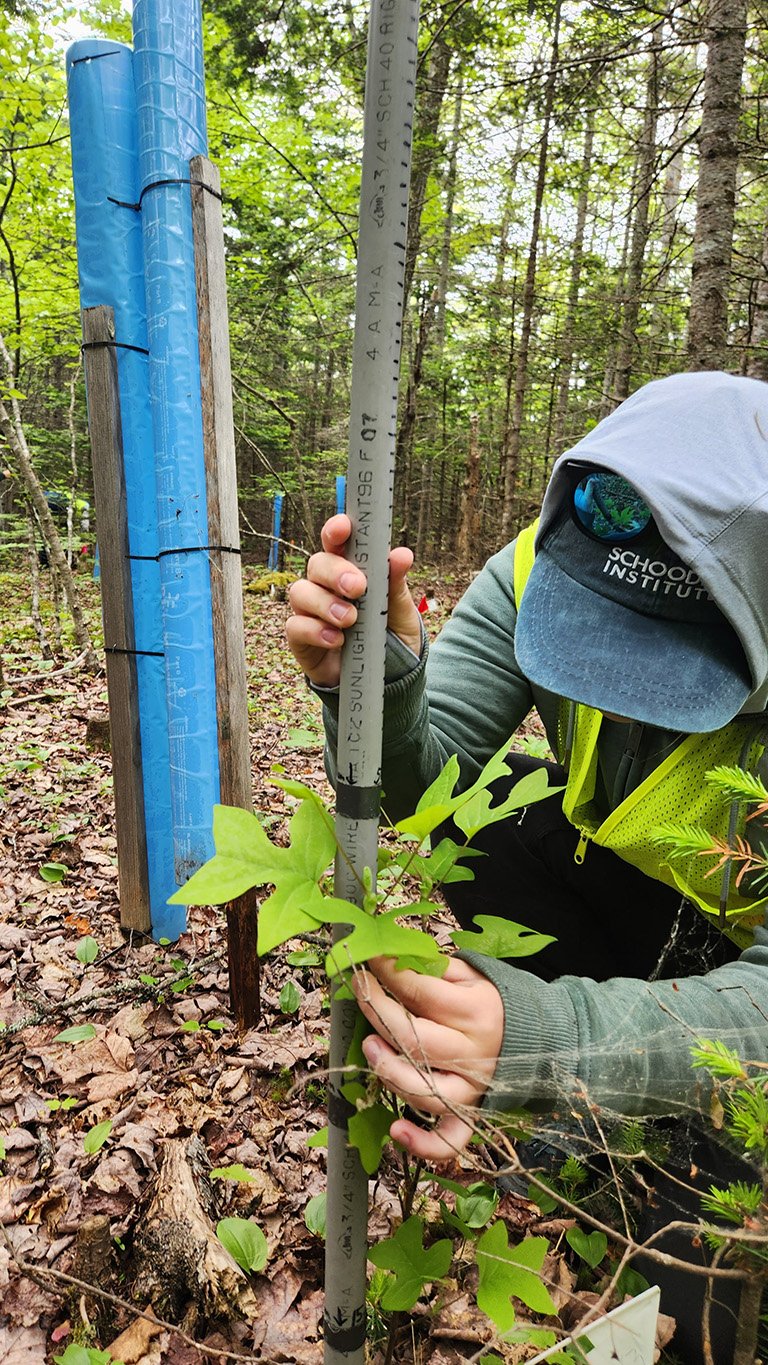
The Future Forests plots will continue to be monitored in the future. Come June, research assistants will visit the trees. They will count how many are still alive, and how many are dead. They will measure the height of the trees, and document whether or not the trees have fully leafed out. Together, these metrics can indicate that a potential species or source population can survive and adapt to local conditions. They will repeat this monitoring in the fall, and again in future years, for as long as funding allows.
Most studies need to run for multiple years or more to yield quality data. Meanwhile, climate change accelerates. Since Schoodic Institute began studying assisted migration, Maine has experienced the driest growing season (2020), the warmest sea surface temperature (2021), and the wettest summer (2023) since record-keeping began in the late 1800s.
The title of the state’s Climate Action Plan is “Maine won’t wait.” People feel a sense of urgency to act, to do something.
Across the state, assisted migration is already underway.
This is Part 2 of a series.
Click here to read all 5 installments in this series.
About the Author:
Catherine Schmitt is a science communication specialist with Schoodic Institute at Acadia National Park. She writes about research in Acadia and across the National Park System, and also provides communication training for conservation scientists and educators. She is the author of The President’s Salmon and other nonfiction books, editor of the Maine’s Climate Future series of reports (2009-2020), and contributing writer for Northern Woodlands and The Working Waterfront. Schmitt’s writing has been been published in numerous other magazines, newspapers, and literary journals. She previously directed communications for the Maine Sea Grant College Program at the University of Maine, where she also was an adjunct instructor in the English Department. Her writing is informed by her scientific background, which includes a master’s in ecology and environmental science and experience studying lakes, streams, wetlands, and beaches throughout the Northeast.