
Owl Stories
Nature Bummin’ with MCHT Steward Kirk Gentalen
I’ll say it again—like a broken record—in my experience, all nature observation is a form of tracking.
The Trouble with “Tracking”

When most folks hear “tracking,” they picture big, bold footprints in snow, mud, or dirt—likely left by some majestic megafauna. And there’s no shame in that! Snowy tracks are a gateway drug for nature lovers everywhere, especially after a storm.
But that image is just the tip of the iceberg. Tracking is way more than paw prints in powder.
Defining the Art
Tracking—in its purest and nerdiest form—means using signs left by animals to learn about them. These signs could be tracks, trails, scat, smells, fur, feathers—or even the absence of something (like silence in a bird chorus).
“I never expect to see the animal. I track for the signs. In fact, most of the time? I’m happy with scat.”
And tracking doesn’t hibernate in the off-season. It’s a year-round pursuit. Sometimes, the signs lead you to the animal itself. Like hearing a warbler and following its song or sniffing out a stinkhorn mushroom (bless your nose). Or, say, tracking otters and ending up with a bonus beaver sighting.
That’s tracking gold. The holy grail. But let’s be real, I never expect to see the animal.
I track for the signs. In fact, most of the time? I’m happy with scat. (Can we get that on a T-shirt?)
Let’s Talk Owl Pellets
Pellets 101: An owl pellet is a compact, regurgitated nugget of all the stuff owls can’t digest—bones, fur, insect parts, skulls. Yes, full skulls! It’s like a time capsule of who got eaten.
While many birds cough up pellets, owl pellets are the crown jewels—they decompose more slowly and contain more skeletal treasure than those of other birds of prey.
I’ll go on record again: Owl pellets are my favorite animal sign to find. Each one offers clues about who the owl is, what it’s been eating, and how long it’s been around. For more, check out MCHT’s classic video on the subject.
“If you find multiple pellets, fresh scat, and leftover prey parts, there’s a decent chance the owl is still nearby.”
How to Track an Owl
Unlike other wildlife, tracking owls can actually lead you to an owl! If you find multiple pellets, fresh scat, and leftover prey parts, there’s a decent chance the owl is still nearby. That doesn’t mean you’ll always see it, of course. I’ll never know how many I’ve almost seen. But still—there’s a chance!
And in this game, attitude is everything.
Not Everyone Loves Pellets
Sure, owl pellets can be gross. But you don’t have to dissect them to learn something. These days, I usually leave them behind for the next lucky person—because what’s better than stumbling across a pellet unexpectedly?

That First GHO Stare
I’ll never forget the first time I saw a Great Horned Owl (GHO) while tracking. 2002. Santa Cruz, California. A eucalyptus tree. Scat and pellets below, owl staring down. We had a moment. One of silent, mutual curiosity. Then I quietly backed away. Seeing an owl is a gift! Leaving it in peace is part of the deal.
Long-Eared Lessons
From 2004 to 2015 I lived on Vinalhaven, where long-eared owls occasionally winter.
The area wasn’t dense with trees, so spotting pellets under individual trees was pretty straightforward. A new pellet meant an owl had likely roosted there the night before. Worth a look, right?
“One roosting behavior of theirs is to get close to the tree trunk, way up high, and roost their with their face pressed up against the bark—practically invisible.”

But long-eareds are notoriously hard to spot. One roosting behavior of theirs is to get close to the tree trunk, way up high, and roost their with their face pressed up against the bark—practically invisible. It took three years of regular checking before I finally saw one.
It was 2:30 PM. I spotted what I thought was a fake owl on a water pump shed. Out loud I said, “What a dumb place to put a fake owl.” Then it flew off. Real owl. Real dumb moment.
So even though it took me years to actually see an owl, I already knew it ate mice and voles. I knew it was around all winter. I even knew which trees it preferred to roost in. Those three years felt long, but the pellets had been teaching me the whole time—probably more than that three-minute sighting ever could.
Great Horned Drama
February 2025. Vinalhaven. I was chainsawing downed logs when I noticed a red spot in the snow—blood. And I do love a good bicatch tangent.
A closer look revealed:

- Crow tracks (the late-to-the-party clean-up crew)
- Snowshoe hare tracks
- And—drumroll—Great Horned Owl tracks.
The owl had landed on the icy crust, grabbed the hare, and dragged its wingtips through the snow in that dramatic “this-is-MINE” posture. I didn’t find the rest of the bunny, but we saw the story etched in snow.
Saw-Whet Surprise
In spring 2017, I was widening a trail when I spotted a single pellet under some spruce saplings. Then ten. Then more. Saw-whet Owl territory.
Every year since, I’ve checked the same spot. The pellets always return—in winter. A seasonal roost.
“Seventeen pellets. One of them hanging in a tree by the prey’s tail…”

Fast forward to March 2025. Fresh scat. Seventeen pellets. One of them hanging in a tree by the prey’s tail—yes, you read that right. A tiny tail caught mid-bounce, snagged on a twig, suspending the pellet in air. By the tail of the processed rodent!
By June, the pellet had dropped. Gravity always wins. But there were even more pellets and new scat. The owls were using the spot in summer now!
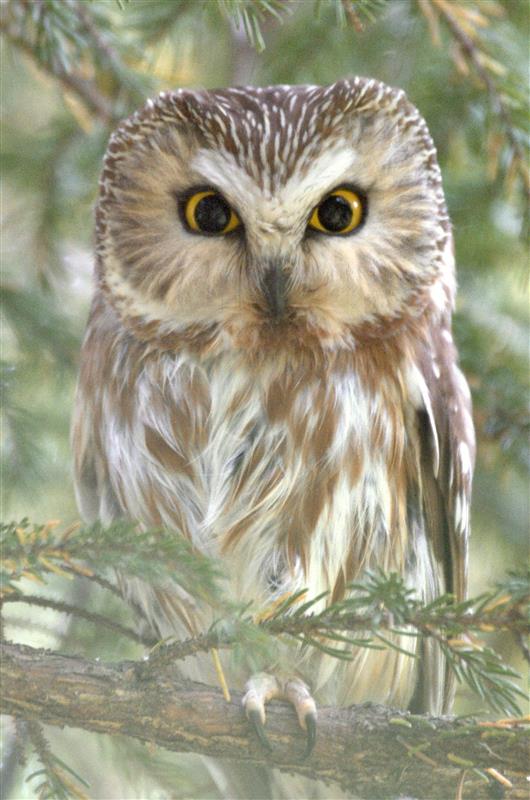
So, I set up a trail cam. Came back a few days later, weedwhacker in hand—and there it was. A Saw-whet Owl. Staring at me.
It didn’t fly. Just watched me with those big eyes.
Maybe as surprised to see me as I was to see it. Ha!
In Conclusion
I don’t remember my first owl pellet, or when I started crawling under trees to look for them. But I’m glad I did. Even if nine times out of 10, I find nothing, I’m always learning something.
Pellets may be gross. Tracking may be obsessive. But this quirky hobby has brought me closer to nature—and sometimes, face-to-face with owls.
Tracking owls through their signs is a practice in patience, persistence, and delight. And if you’re lucky—just maybe—you’ll get those big eyes staring back at you, too.