Nature Connects: Working forest in Jackman helps anchor a community’s vision for its future
A rural Maine town, in partnership with conservation and sporting groups, is mapping out a four-season strategy to build economic resilience and support the community for generations to come.
By Tom Duffus and Rick Petrie | August 2026
Drive north on Route 201 past Moose River in northwestern Maine, and the Hilton Family Forest opens to reveal 41,000 acres of mountains, rivers, waterfalls, and maple sugarbush stretching toward the Canadian border. For generations, this land has been a point of pride for the people of Jackman and the surrounding communities, who have long relied on its vast resources. It’s a place where people hunt, where sap runs each spring, and where residents head out on snowmobiles and ATVs after the workday ends.
But two years ago, the future of this land – and the community’s access to its resources – was suddenly in question.
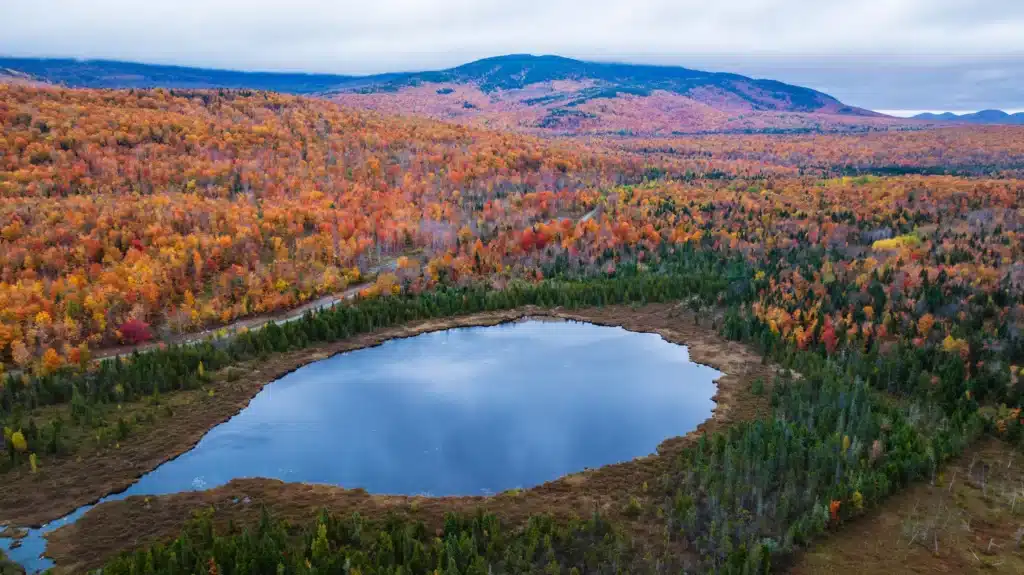
Hilton Family Forest by Jerry Monkman, courtesy of The Conservation Fund.
When the Hilton Family Forest went up for sale in 2024, uncertainty rippled through the valley, including among maple producers. Somerset County produces the overwhelming majority of Maine’s maple syrup, almost all of it on leased land. Maple producers who had been leasing sugarbush lots for decades worried about losing access to the forests they depended on for their livelihoods.
Not long after the land went up for sale, The Conservation Fund – a national land trust with offices in Maine – purchased the property. The goal was to keep the land forested and productive, while working with local leaders to develop a permanent solution that would allow the timber, recreation and maple industries to continue supporting the community in the future.
Now, two years later, the forest continues to function as it has for decades. Timber is managed, sugarbush is tapped, and the land remains open for hiking, hunting, fishing, snowmobiling, and ATV riding. The recreation industry has long been an important economic driver for the region. In fact, Jackman and Moose River were home to the first organized snowmobile club in Maine, and snow-sled trails have run through this land for generations.
Meanwhile, Jackman’s leaders have been working in close partnership with The Conservation Fund to map out a forest conservation strategy that aligns with the town’s four-season vision for its future. This includes plans to stabilize the popular Slidedown Falls Trail, as well as a feasibility study to improve trail conditions on Boundary Bald Mountain. Through a planning and engagement process, co-facilitated by The Conservation Fund and Outdoor Sport Institute, a local stewardship group is taking shape to care for these trails long-term, and to plug Jackman into statewide recreation-economy efforts already growing in other parts of Maine.
These initiatives aren’t yet fully funded. However, early projections, modeled on similar trail systems in rural parts of Maine and New England, suggest the potential to generate over $100,000 annually within the first five years of investment, growing to over $300,000 annually as the trail network and regional recreation vision matures. That revenue could directly support local outfitters, guides and other businesses.
Efforts to safeguard this land have important environmental implications as well. The Hilton Family Forest is home to four high-elevation peaks and the headwaters of the South Branch of the Penobscot River. Conserving this land means conserving critical habitat for multiple rare plant and animal species, including the golden eagle and the peregrine falcon.
What began as a conversation about maintaining access to working land has evolved into a conversation about what this forest, and others here, can help the town build: economic resilience, a stronger recreation economy, and new partnerships across the region.
These conversations are taking place in rural areas throughout Maine. As forestland continues to change hands, local communities and conservation groups are joining forces to protect working landscapes. For example, at the Chadbourne Tree Farm in the western part of the state, a similar working-forest approach is helping advance a long-held local vision of connecting the Sunday River and Mount Abram ski areas through an all-season trail network.
These efforts serve as one model for what community-based conservation can look like. Done well, conservation is simply one tool that can help a community build the future it envisions for itself.
The work in the Hilton Family Forest is far from finished, but the people who call this valley home are informing what happens next.
ABOUT THE AUTHORS
Tom Duffus is vice president and state director for The Conservation Fund in Freeport, Maine. Rick Petrie is town manager of Jackman, Maine.
“Nature Connects” is a monthly column showcasing conservation stories from people and organizations across Maine. To learn more or suggest story ideas, email reply@mcht.org.