
Dots on the Rocks: Purple Sandpipers
Nature Bummin’ with MCHT Steward Kirk Gentalen
Maine Coast Heritage Trust’s Midcoast Regional Stewardship Manager and author of Nature Bummin’ Kirk Gentalen was recently featured in Birdwatcher’s Digest!
His article, “Dots on the Rocks: Purple Sandpipers,” highlights his experiences with and musings on these winter shorebirds, along with some of his fantastic wildlife photography.
The Rockland Harbor Breakwater is a level arrangement of granite rocks that protects Maine’s Rockland Harbor from storms, waves, out of control boats, and whatnot. It’s a little less than a mile long and open to the public. With a picturesque lighthouse at the end, it can be busy any time of the year. Pick the right day, and the place can be brimming with families, dog walkers, fishing folk, nature observers, and lovers strolling hand in hand.
On this February day, I was walking the break water with my wife, son, and one of our dogs, a pleasant family outing on a pleasant winter’s day. Seawatching is always part of our winter break water stroll, and in the first half of this walk, we focused on seabirds. Common loons and eiders, longtailed ducks and razorbills dove over and over in search of tasty treasures below.
Soon the family unit separated with my wife and kid (and dog) moving farther and farther ahead while I slowed and slowed… and slowed, until I ceased moving altogether. Amy, Leif, and Roxy the dog didn’t have to guess what stopped me in my tracks. It was, of course, the purple sandpipers!
Purple sandpipers are the East Coast winter shorebird of the rocks. And the rocks are so close as to be underfoot when you are on the break water. So, too are the purples. In fact, they are so close and so observable that it was highly unlikely I was going to walk any farther that day. Purple sandpipers are the ultimate turn around spot.
Rare is the winter Rockland breakwater visit without purple sandpiper sightings. Five to seven purple pipers on a winter Rockland breakwater walk is about average. But I’ve seen up to 15 individuals on a single visit. Purples are reliable here from December through April. There are even a few in November and May. It’s nice to have something you can count on in the winter!
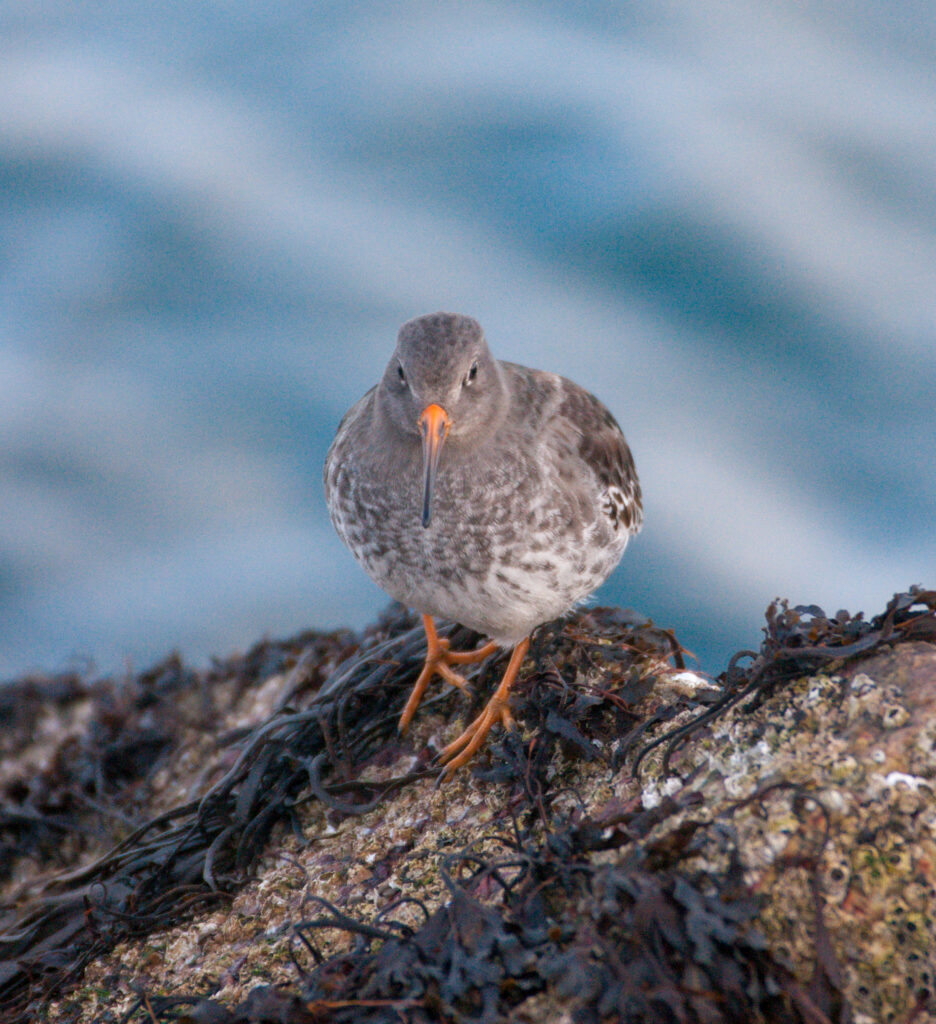
On this chilly day, the 3rd of February 2024, five purple sandpipers were chillin’ on the break water rocks no more than 12 feet from me. Even though I was looking for purples as I walked, I’m usually a little startled when I come up on them. There is a “Whoa!” moment accompanied with a sudden stop and drop into The Squat. The Squat puts the observer on eye level with the purples. Not looming over them lessens the fear factor in the sandpipers. With the birds calm and doing their own thing, we can all relax while I observe and document. (Side note: Moving while squatting makes for a comedically low approach that I call the Squatter’s Waddle.)
The purples certainly knew of my presence, but they didn’t seem too bothered. Most were resting when I first spotted them, with three keeping an eye out for predators and walkers. Two purples had their eyes closed and bills tucked under their back feathers as I approached. So, I dropped to my squat to let sleeping sand pipers lie (or, more properly, stand). Resting was just one of several cool behaviors the purples exhibited that day. What a show they put on!
After nap time was over, they soaked in the sun’s warmth, stretched their wings, and a few even pooped before beginning their preening and feather maintenance routine. Heads were rubbed on backs, preen glands squeezed, and oils spread over and between feathers. Feather maintenance is very important when you spend your winters on rocks in coastal Maine! At one point, a couple of the purples made their way to the ocean for a little saltwater bath. Done in the name of survival, the baths were short and, I’m sure, bracingly cold.
For the most part, the purples chased down and picked up food between crashing waves. Like sanderlings on a beach, the purples were after tiny crustaceans and mollusks on the rocks and rockweed—the feast was on! It was a crowd pleasing performance.
Measuring at an impressive nine inches from the tip of the bill to the tip of the tail, purple sand pipers are small shorebirds that actually fall on the larger side of the Calidris genus size spectrum. They are kinda chunky, some might say plump, with short orangeyellowish legs. Purples are more reminiscent of a dunlin or red knot, rather than other Calidris.
And sure, some years the random dunlin will overwinter along the Maine coast, but with a good view, you should see a purple sandpiper’s orange yellow legs and base of the bill. At a good distance, the distinctive dark hood of a purple sandpiper is evident. And after you see one, you’ll realize that the vast majority of all winter shorebirds on the rocks in midcoast Maine are purples.
In early February, these purples were all decked out in their basic, nonbreeding plumage. In other words, they actually kinda looked purple, or as purple as they are going to look. When the light hits a purple’s winter slategray hood in the right way, you might notice a purplish glaze, maybe even a purple splash on their wings. But they only wear their hoods in winter, which is some thing I absolutely love about them.
Purples are an example of a species that gets its common name from its basic, nonbreeding plumage. There are a variety of reasons a species is given a common name based on this phase of molt, but often it’s a case of either (A) their breeding plumage is dull when compared to nonbreeding plumage (yellowbellied flycatcher, for example) or (B) it’s a species that “we,” meaning humans in the Lower 48, see only in winter.
This naming makes sense since purple sand pipers breed way up in the arctic/subarctic regions from Canada to Siberia. They also have the most northerly distribution of any shore bird in winter. Purples that over winter on the western shores of the Atlantic Ocean will spend the winter as far north as Labrador!
Nowadays they can be seen south to the Carolinas and in the Gulf of Mexico, but before rock jetties and breakwaters were built to protect southern harbors and support New Jersey light houses, an observer would be hard pressed to find a purple south of New England. Back then, before jetties were built down to the Gulf Coast, you really had to earn a purple sandpiper sighting.
Distracted by Dots
I was living on Cape Cod the first time I saw a bunch of purple sandpipers. It was during the school year 1996–97, and I was working at an environmental education center in Truro, out toward the end of the Cape. My parents were living in Jersey, and so I—being the wonderful 25 year old son that I was—would drive down once a month or so to hang with them. The five hour drive from the Cape to Jersey was way too long for me to do in one shot, so I would search out places to stop and observe, to break up the drive, stretch the legs, and bust out the scope and binos.
In autumn, I visited a couple of Connecticut state parks to look for butterflies and mushrooms, and when spring came around, I would make a few songbird stops. But during the winter of ’97, there was only one place that was on my list on every drive south. That was the Sachuest section of the Rhode Island National Wildlife Refuge complex. There swam harlequin ducks!
Let it be known that there is a distinct short age of harlequins on the Cape. This is largely due to lack of rocky habitat for harlequins. (Is it too late to request more glacial erratics?) There were some for sure, but the potential of seeing 50+ harlequins and still getting to see my parents… well, that was enough for me to make a monthly pause in Rhode Island and scope things out. And there were plenty of other distractions as well.
A distraction. That’s what the purple sand pipers were for me the first time I saw them, in early March 1997. I was already distracted from the Sachuest harlequins by a flotilla of common goldeneyes. Several male goldeneyes were trying to impress a female. It was hard not to watch.
I’d never seen the goldeneyes’ headthrowing display. The ducks were in their own little world of courtship tension when they slowly floated by a ledge with little white dots on it. And then the dots moved! Well sir, if it wasn’t shorebirds on the rocks in a New England winter! That was a new concept for me, and that’s what purple sandpipers do. They break several molds of shorebird behavior, being virtually the only ones to hang around all winter on the Northeast coast.
I returned to Truro, and that environmental education center, for the 98–99 school year, and scanned and found Sachuest purples on every visit that winter. I also got a better scope and would pick a handful of purples out on the rock jetty that protects the Provincetown Harbor (even farther out on the Cape than Truro). These were truly dots on the rocks, and I didn’t realize it could get any better.
5 Years Later …
I was now married and my wife Amy and I moved to Vinalhaven Island, Maine. The year was 2004, the month was October, and the Red Sox were about to win the World Series for the first time in forever. Yes, those were exciting times. As if living on an unfamiliar island wasn’t exciting enough, this island came with its own hour and fifteen minute ferry ride, right through the heart of Western Penobscot Bay. Yippee! Observing from the Vinalhaven ferry can be dreamy. While you can see harbor seal mothers and pups in the spring, and phalaropes and storm petrels in summer most years, winter is when the ferry rides fill with sightings of seabirds, ducks, and purple sandpipers.
Sometimes my friends and I speak in terms of “trifectas” to sum up a day in the field. There can be dozens of cool things to observe from the Vinalhaven ferry in winter. Our standard ideal trifecta usually consists of a combination of black legged kittiwake, razorbill, great cormorant, and purple sandpiper. Ferry rides are better with purple sandpipers, and that is a scientific fact.
We lived on the island for 11 years. But I still ride the ferry to Vinalhaven every week for work, and I am so happy with my commute. I still count the dots on the rocks; they are always a treat to see.
A Lesson in Counting
For my first job on Vinalhaven I was hired to ride aboard Fluke with Captain John Drury, spokesman for the great cormorant and the most successful guide to the legendary redbilled tropicbird on Seal Island (2010–2021). I wasn’t part of the tour business, but rather a hired bino to be a second on harlequin duck counts around Isle Au Haute to Marshall Island in winter. We were surveying the largest concentration of harlequins on the East Coast, and days with counts of over 1,000 harlequins were not unheard of. I’m not going to lie—it was awesome.
Eventually we got hired to be part of the “from the water” portion of the great purple sandpiper count of 2008. This was a lesson in counting, as most of the purples we would count were groups in flight. Flocks of 60–100 were occasionally seen on this survey, and John had stories of his father, Bill Drury, throwing handfuls of rice onto a table in an effort to replicate purples (and other sand pipers) in distant flight. Bill did that so the kids would practice counting quickly. That’s a cool dad.
And so John would count and I would count and it was wonderful when our counts matched (which was almost always). This survey was sponsored by the Maine Natural History Obser vatory, which has recently rebooted the purple sandpiper surveys. I’m looking forward to seeing what they find out. A notable trifecta from the 2008 purple sandpiper count was a day with Atlantic puffin, harlequin duck, and wood duck. Now that was a good day.
When we moved to mainland Maine in 2015, to a place called St. George, not far south of Rockland and the ferry terminal for Vinalhaven, I’d been searching for purples for almost 20 years and still had not gotten a decent look at one. One day my family ended up walking the Rockland Breakwater. It was by accident, a Mother’s Day where blackflies had chased us out of our local woods. Where to go? The breakwater makes for a wonderfully breezy alternative to a stagnant woods full of buggy bloodsuckers in May. (And it makes for a good seawatch in winter.)
May 13, 2024, was a day with low expectations. There seemed like a decent chance I would make it all the way out to the lighthouse. That of course was not meant to be.
Because there they were—purple sandpipers. Maybe the same from the winter? Maybe some that had flown in? They looked different—decked out in alternate/breeding plumage, biding their time until their thawing tundra breeding grounds were ready for them. How could they possibly know from the Breakwater what was going on in the islands of northern Canada? Length of daylight I suppose. They would head north soon enough…
In alternate plumage, the purple hoods were gone, replaced by streaks and browns that made them look like a lot of other sandpipers. Their legs and bill were the same orangey-yellow, and the portly overall look remained. Oddly, I can’t f ind a good description of a purple’s breeding plumage—at least not one that I like.
To me, they show lots of scalloping on the head and breast, and maybe a little rufous splash on the back. Alternate plumage reminds me of a surfbird, but when it comes down to it, they look like purple sandpipers, just without the purplish hood.
No need to worry, though, if the birds on the rocks are confusing in May. We don’t see purples like this for long. Soon enough they’ll be back, purple hoods and all.
Purple Sandpiper (Caldiris maritima)
What to Look and Listen for
A plump, dark-hooded shorebird invariably found on wave-swept rocks. Striking orange legs and bill base. Winter plumage is a dark, glossy gray, with shots of rufous in the wing coverts, and snowy-white underparts, with streaks running down from a bib of gray. Rarely seen breeding plumage is checkered with bright rufous, black, and white from head to tail. (Note: In basic [nonbreeding] plumage, purple sandpipers are virtually indistinguishable from rock sandpipers of the Pacific coast, but their ranges do not overlap.)
For most of the Atlantic states, purple sandpiper watching is all about looking for “dots on the rocks” (and ledges, jetties, and breakwaters) from November to mid-May. So, look at rocks! And even better yet—be on the rocks! Be careful not to slip, and note your increased heart rate when you see them!
Where and When to Look
Purple sandpipers breed across the Canadian arctic east to Greenland and Scandinavia, to western Siberia and the Taymyr Peninsula. It is North America’s northernmost wintering shorebird, foraging on ice-free rocks from Newfoundland down the Atlantic coast as far south as South Carolina, with scattered reports along the entire coast of Florida all the way to Texas. They are found in the Great Lakes in winter as well as on seacoasts.
Historically, one might have had to venture to New England to find the rocky habitats purple sandpipers prefer. Humans are good at making stuff, however, and the building of rocky breakwaters and jetties to protect harbors and land along the East Coast has expanded the winter range of purple sandpipers all the way down the Gulf Coast!
Feeding Behavior
Visual hunters, they move quickly across rocks to pick invertebrates. They forage at low or falling tides, even at night. Crustaceans, mollusks, gastropods, worms, and wrack flies are picked from rocky crevices and splash zones. On the tundra, purple sandpipers pick prey— insects, spiders, etc.—from vegetation.
Courtship and Nesting Behavior
Male purple sandpipers perform a flight display full of flutters and stiff-winged glides rising up to 80 feet, followed by wide circular glides with head up and chest out as they voice a ratchety, creaking song, punctuated with long kreeee notes. The flight and song conclude with a rapid zigzag descent to the ground with wings held up in a “V.”
Purple sandpipers are monogamous. Males make up to five scrapes, lined with grass and lichens, in the ground. The female selects one and lays four eggs. Male and female share incubation duties, but the female departs after hatching, and the male is left to raise the precocial chicks alone.
Taxonomy and Conservation Concerns
No subspecies of purple sandpiper is currently recognized, but size variation from smallest (breeding along James and Hudson Bays) to largest (Iceland breeders) is documented.
The International Union for Conservation Network judges purple sandpiper to be a species of least concern as far as threats go. With a restricted range, and a North American population estimate of perhaps 25,000 (compared with 250,000 in Europe), the species bears watching. They are vulnerable to oil spills, rising sea levels (which will eliminate foraging habitat), and pollution.
Reprinted with permission. (c) 2025 BWD Magazine