Notes from the Coast Spring 2025
In “Notes from the Coast,” we delve into a particular topic
area, share thoughts and questions we’re exploring at Maine
Coast Heritage Trust, and celebrate the good work you’re
making possible.

Kate Stookey
MCHT President and CEO
THE GUIDING QUESTION
hat role can and should MCHT and Maine’s land conservation community play in advancing the state’s Climate Action Plan?
Maine has more open lands and relatively intact ecosystems than many other states, with roughly 3,400 miles of coastline, more than 4,600 offshore islands, over 32,000 miles of rivers and streams, more than 6,000 lakes and ponds, and almost 18 million acres of forestland. These natural features are an important part of Maine’s appeal for longtime residents, new Mainers, and visitors. They are also a tremendous asset in a changing climate if we can conserve them.
Maine’s updated Climate Action Plan prioritizes the conservation of natural and working lands with a focus on, among other things, strengthening the Land for Maine’s Future program (LMF), the state’s preeminent land conservation program; conserving biodiversity and connected lands; and the protection and restoration of coastal habitats, particularly tidal marshes.
In all of these arenas, MCHT plays a leading role. MCHT helped launch LMF and has been championing the program for decades. MCHT has contributed to the conservation of over 190,000 acres for ecological and community values. As MCHT commits to increasing the pace and scale of conservation and prioritizing the protection of interconnected landscapes and tidal marshes, the Climate Action Plan is reaffirming the state-wide goal of conserving 30% of Maine’s lands by 2030. Working toward this goal requires collaboration and creative approaches to protecting our shared heritage.
As we host this year’s annual Maine Land Conservation Conference, we will be asking our land trust colleagues: How can we most efficiently and effectively work together to meet this moment? And: How do we get more people to understand the value of conservation in a changing climate and inspire them to care about and participate in these efforts? In Maine, nature is still big and bold, and so are the opportunities to conserve our beloved lands and waters for a healthier future. What do you think? Please share your thoughts and questions with me at president@mcht.org.
What do you think?
Please share your thoughts and questions with me!
THE MOMENT OF INSPIRATION
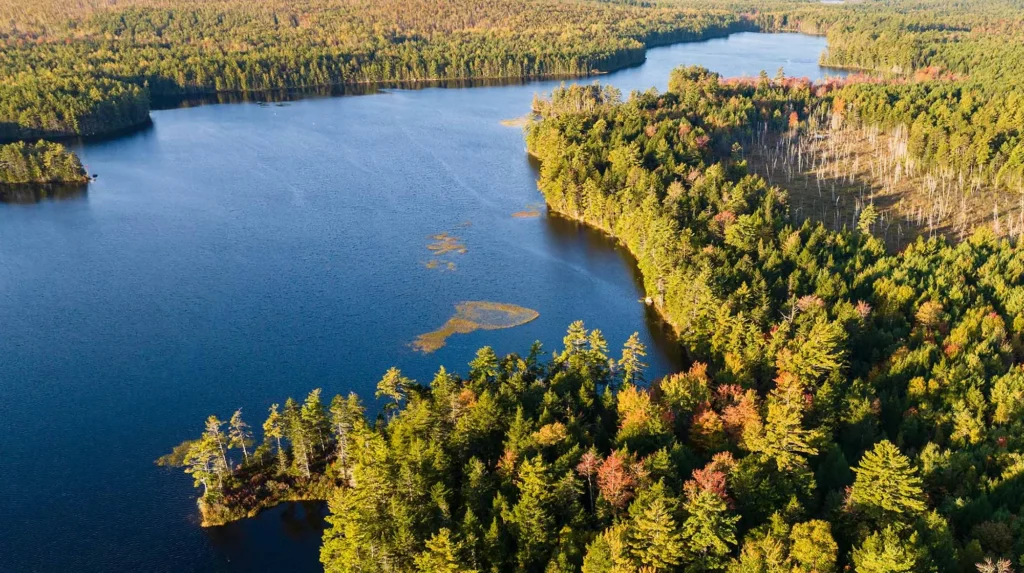
In 2024, Maine Coast Heritage Trust played a role in conserving over 5,000 acres at the headwaters of the Narraguagus River. Within the Narraguagus watershed, a focus of our Rivers Initiative, MCHT has contributed to a collective effort resulting in the conservation of over 26,000 acres and a variety of restoration efforts to enhance the ecological resilience of this extraordinary Downeast river and the region at large.
A PARTNER I’D LIKE YOU TO MEET
Justin Schlawin
Program Coordinator, Beginning with Habitat

Staff of the Beginning with Habitat program (within the Maine Department of Inland Fisheries and Wildlife)—who work to equip Maine communities, landowners, and conservation partners with information and tools to protect, restore, and connect important habitats and ecosystems in a changing climate—have their work cut out for them. Beyond identifying places of ecological value today, Justin, his colleagues, and partners, including MCHT, are asking what success looks like if we can maintain a resilient and biodiverse landscape 100 years from now.
The Beginning with Habitat program is working with a diverse range of partners across land use sectors to better understand regional needs and priorities and develop a “conservation blueprint” for the state. With the big-picture vision to work toward, and guidance at the local level, MCHT and others caring for Maine’s lands and waters will be even better equipped to contribute to the state’s ambitious conservation goals.
DID YOU KNOW?
Maine land trusts are collectively responsible for most land conservation in the state, about 12%.
Over the past 40 years, MCHT and partners have worked with policymakers and partners from both sides of the aisle to support the conservation of 650,000 acres through the state’s Land for Maine’s Future Program.
Maine is the most forested state in the U.S.; our forests absorb more than 70% of the state’s annual carbon emissions. Marshes absorb up to ten times as much as forests on a per-acre basis.
Protected wetlands provide natural water quality improvement, flood protection, shoreline erosion control, and more—ultimately contributing to our safety and welfare.
Source: 1 and 2. Land Trusts Work for ME report 3. Maine.gov 4. epa.gov
Photo of Narragaugus River: Jerry Monkman of Ecophotography
Photo of Kate: Katherine Emery
Photo of Justin: Courtesy of Justin Schlawin