MCHT is pleased to announce it is applying for renewal of accreditation. The Land Trust Accreditation Commission, an independent program of the Land Trust Alliance, conducts an extensive review of each applicant’s policies and programs. MCHT was accredited in 2010, reaccredited in 2016 and in 2021, and is again applying for reaccreditation in 2026. A public comment period is now open.
Conservation is often measured in acres protected or miles of coastline preserved, but the impact of MCHT’s work extends beyond simple statistics. Conserved lands and waters create habitat for wildlife; increase biodiversity; strengthen resilience to the impacts of a changing climate; contribute to healthy local economies; safeguard access for traditional, commercial, and recreational activities, such as fishing, farming, hunting, hiking, and boating; and help preserve the character and vitality of Maine communities.
Like the ecosystems we work to protect, conservation is constantly evolving. At MCHT, our work in 2025 increasingly included partnering with communities and organizations to address shared challenges — such as affordable housing, access to land and water, food security, and sustainable and working waterfronts — and create lasting benefits for people and nature. Community conservation efforts like these expand the relevance and visibility of our work in ways that are tangible, immediate, and connected to people’s daily lives and livelihoods.
Across the state, year by year, MCHT is continuing to learn what’s working, where we need to adapt, and how we can meet the needs of today’s communities while conserving this special place we call Maine for generations into the future.
Our 2025 impact report highlights what our collective outcomes look like: Together with our partners and supporters, we were able to conserve close to 10,000 acres, including more than 35 additional miles of freshwater and saltwater shoreline, and ensure that more of Maine’s lands and waters remain permanently open to the public. Thank you for making this possible.
With gratitude and excitement for what we will achieve together in the year ahead,
PS. Did you notice we adopted a new logo? This new look was designed to reflect the breadth and vitality of conservation work today. We are grateful for the grant funding that made this possible and hope you enjoy this new splash of color and life! Click on the logo to learn more about how this logo evolution strengthens our brand.
Thanks to the generous support of people who care deeply about Maine, MCHT …
Coordinated 145 events and programs — reaching 4,675 community members and conservation colleagues — and held 48 events for over 800 volunteers.
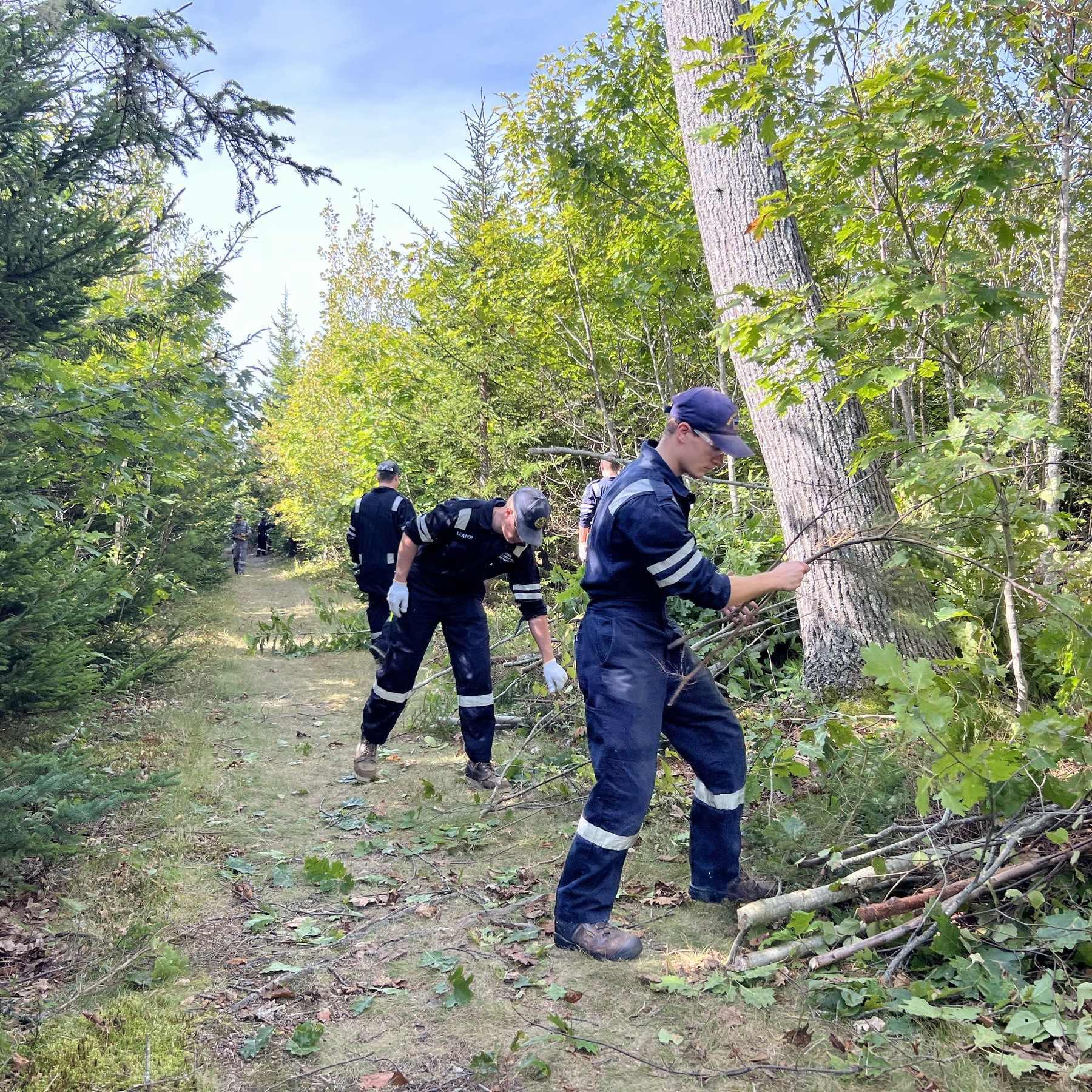
MCHT and Maine Maritime Academy (MMA) formed a landmark partnership to promote public safety, environmental stewardship, and student leadership in response to ongoing concerns about unpermitted fires and associated wildfire risks in Maine. Last fall, more than 150 members of MMA’s incoming Regimental class participated in a half-day wildfire risk mitigation event focused on reducing fuels and enhancing the firebreak in the southern section of MCHT’s Witherle Woods Preserve in Castine.
Completed 5 new priority river projects across three coastal watersheds totaling about 543 acres.
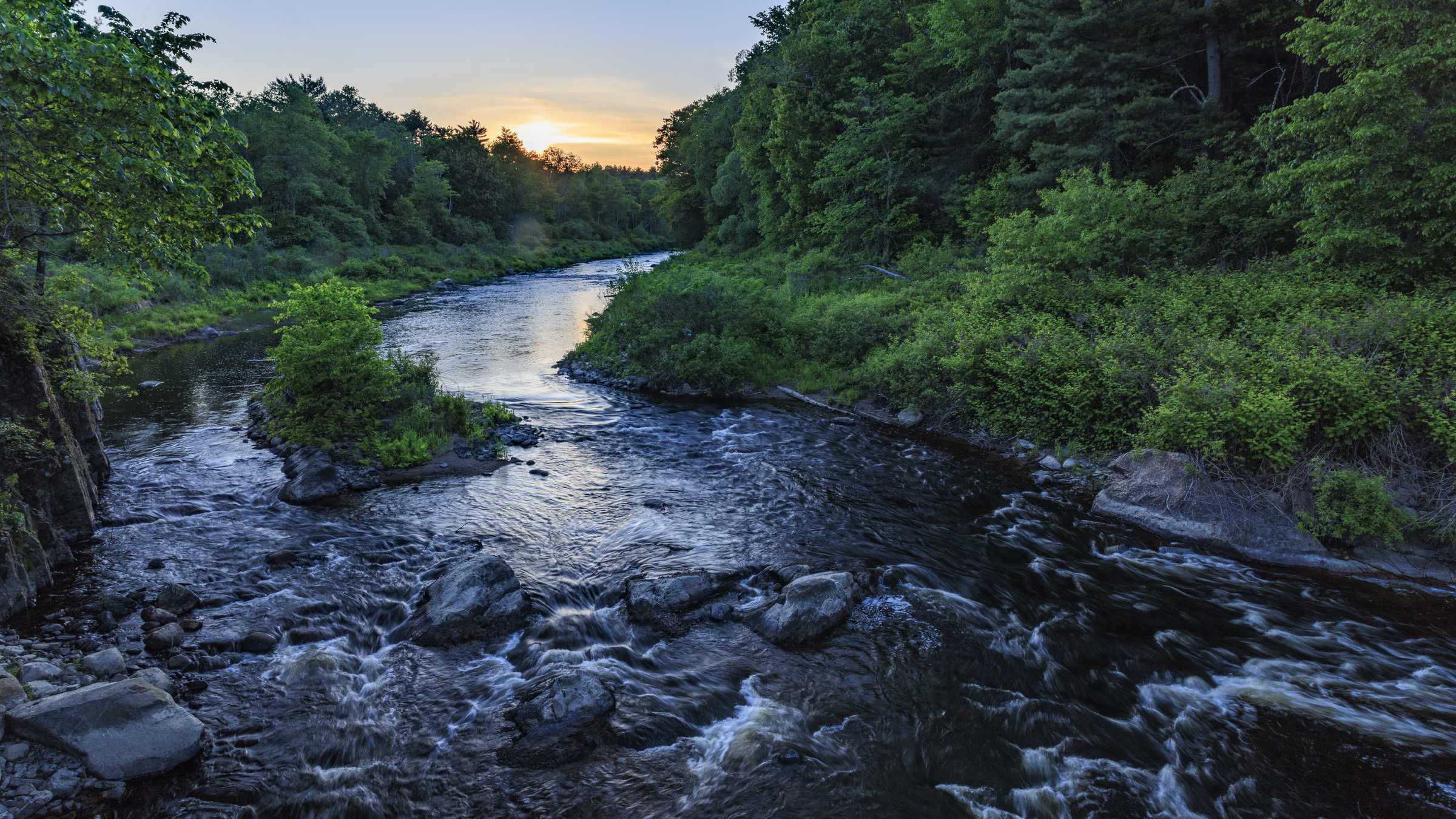
Building on our ongoing collaboration with the Downeast Salmon Federation (DSF) to strengthen the health and resilience of the Narraguagus River in Downeast Maine, MCHT partnered with DSF to preserve 150 acres of land above Little Falls. This addition expands community access to the river and complements removal of the Ice Control Dam in Cherryfield, clearing passage for sea-run fish, including endangered Atlantic salmon.
We completed active restoration at Old Pond Marsh in Hancock, wrapping up a years-long partnership effort to restore the marsh’s natural function and water flow. This project, which launched our statewide restoration program, is showing how restoration helps plants grow back and marshes move inland as sea level rises.
Completed 4 land return projects totaling over 26 shorefront miles.
Alongside many other land trust partners and organizations like First Light and the Wabanaki Commission on Land and Stewardship, Wabanaki nations, and Wabanaki-led nonprofits, MCHT helps acquire and return land to Wabanaki stewardship and increase Wabanaki cultural access to conserved lands. This work is critical to ensure that all people benefit from conservation of lands and waters in Maine.
Pictured from left to right: Nicole Francis, member of the Mi’kmaq Nation, Andrea Francis, member of the Mi’kmaq Nation, and Alivia Moore, citizen of the Penobscot Nation — three co-directors of Niweskok, a Wabanaki-led food sovereignty organization.
Brought together 420 people for two full days of activities and networking, including 14 workshops, at the annual Maine Land Conservation Conference.
At the annual Maine Land Conservation Conference, the co-directors of Wabanaki-led food sovereignty organization Niweskok received the Espy Land Heritage Award, endowed in honor of long-time MCHT President Jay Espy to recognize exceptional individuals and organizations for their dedication and success in protecting the character of Maine. Through their dedication to acquiring Goose River Farm in Swanville as a permanent home for Wabanaki agriculture, cultural education, and stewardship, Niweskok exemplifies a powerful model of land conservation: a model of creating a space where ancestral knowledge, seed saving, wild harvesting, and intergenerational learning can thrive.
Photo by Rooted in Light Media
Your impact in 2025
Your support of Maine Coast Heritage Trust enables more than just the permanent conservation of land — it expands public access, increases coastal resilience through marsh restoration, improves the health of rivers and watersheds, advances meaningful efforts to reunify Wabanaki Peoples with ancestral homelands, and so much more. Thank you for your partnership and all that we accomplished together in 2025.
In Maine, we are fortunate — nature is still big and bold, and it delivers stunning reminders that we are part of it.
MCHT collaborates with landowners, communities, organizations, Tribal entities, and others to meet the challenges Maine faces and set the state up for a healthier future.
We do this by:
Protecting critical wildlife and biodiversity, and creating more public access to the land and sea.
Caring for and managing the land over time to enhance its ecological and community benefits.
Connecting people to the land, restoring relationships between people and place, and building awareness.
Statewide Impacts
Last year, MCHT’s Maine Land Trust Network (MLTN) program helped advance Maine’s conservation movement by hosting the annual Maine Land Conservation Conference and Richard G. Rockefeller Conservation Internship Program; disbursing grants and funding; providing organizational assessment and capacity support; and developing a 2026-2030 strategic plan. We also helped raise $9.8 million in collaborative conservation efforts, on top of $20.7 million in commitments made directly to MCHT.
Public Policy Wins
In 2025, MCHT worked at the State House in Augusta on several bills impacting Maine’s 80+ land trusts. Legislative wins included partnering with Land for Maine’s Future staff to revamp the state’s conservation lands registry; joining with other land trusts to improve Maine’s landowner liability protections associated with conservation projects; and collaborating with The Nature Conservancy, Sportsman’s Alliance of Maine, and others to secure legislative approval for regulations that will mitigate renewable energy development impacts to critical wildlife habitats. MCHT also successfully defeated a variety of proposals that sought to undermine land trusts and land conservation activities in Maine.
35
miles of freshwater and saltwater shoreline protected
26
places permanently protected
16
partnership projects completed
2
islands protected
16
new places permanently open to the public
10,000
acres conserved
11
coastal river and tidal marsh projects completed
39
acres added to four existing preserves
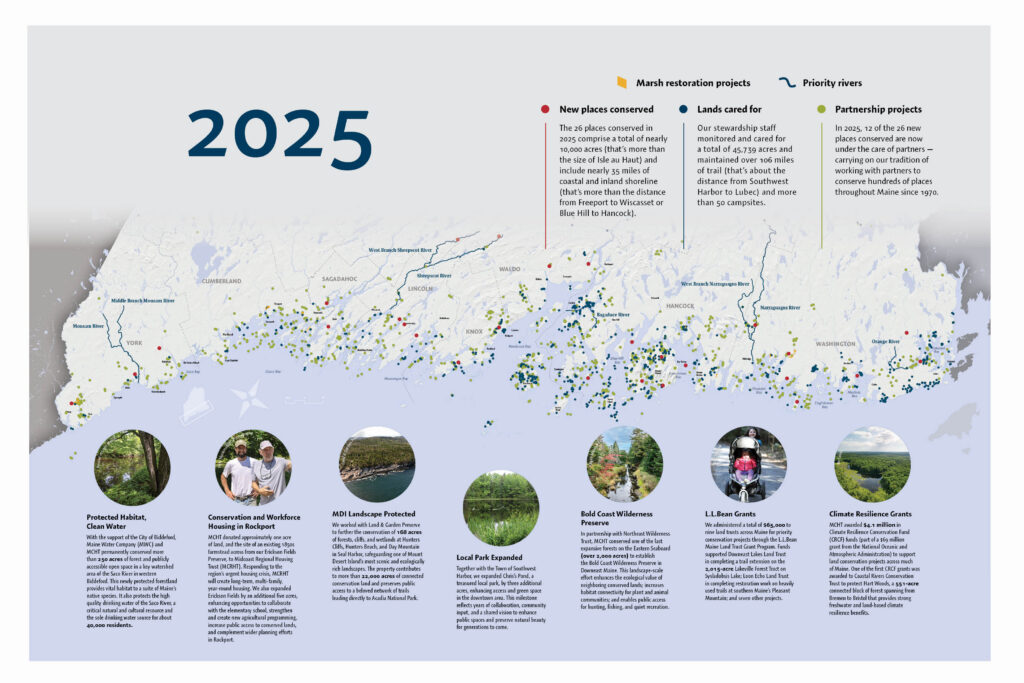
Mapping the Impact
The maps below span the entire coast of Maine and showcase some of the work made possible thanks to donor support. Click anywhere on the map to make it larger. This entire report, including the full map, can be downloaded here.
3,384 donors gave to MCHT in 2025, with 372 giving for the first time. (If you’re a new donor, welcome to MCHT! We’re so glad you’re here.) 432 donors gave monthly, which helps us be more proactive and strategic in our conservation work. We’re grateful to have 797 donors giving at The President’s Circle level.
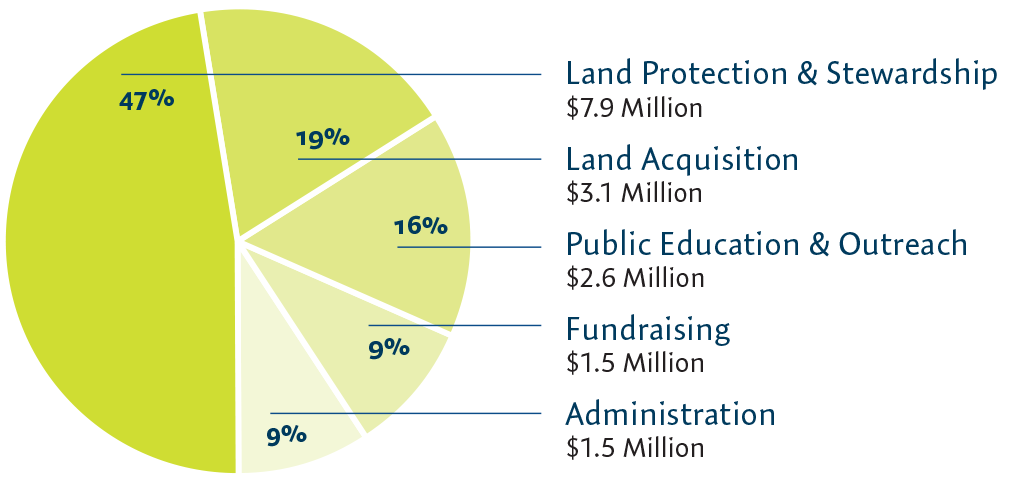
82% of your gifts directly supported conservation
Every conserved acre, restored marsh, and protected shoreline highlighted in this report was made possible by people who care deeply about Maine. For every $10 MCHT spent in 2025, $8 went directly to protecting and caring for coastal lands and islands, safeguarding critical wildlife habitat, and connecting people to the coast.
Here’s one example: We distributed 16,933 pounds of fresh produce from Erickson Fields and 204 pounds of ground beef from Aldermere Farm to area food assistance sites.
I was drawn to Maine Coast Heritage Trust because they embody the meaning of community conservation and I wanted to give as much as I could and to work with the amazing people who make it happen.” Alix Hopkins Council member, President’s Circle donor, and volunteer
Our dedicated volunteers
Our board of directors, advisory council, and volunteer committees continue to grow with passionate people who bring both their dedication and expertise to help MCHT achieve its mission. We thank them for their commitment to conservation, their invaluable guidance, and their partnership in advancing our work.
Be Part of the Movement
It’s going to take all of us to build resilience for Maine’s lands, waters, and communities in a changing climate. Whether you’re contributing to our annual fund, participating in a special project, or making the Maine coast your legacy as part of The Legacy Circle, there are so many ways to get involved and protect the coast in perpetuity.
Our mission is to advance the conservation of lands and waters in Maine to ensure ecological wellbeing and foster thriving communities.
Our vision is to create a world in which the lands and waters that sustain life are healthy, resilient, and an enduring source of connection for all.
MCHT staff, board and council members, and volunteers advance the conservation of lands and waters in Maine with joy and passion!
We Value:
Enduring Commitment
We recognize that caring for land and water is a lasting responsibility and a privilege, critical to the health of our communities, our state, and the wider world.
We show up, thoughtfully and consistently
We speak up for nature and wildlife
We follow through and hold ourselves accountable
Respect For All
We understand that as in nature, diversity builds resilience. By welcoming people’s unique identities, experiences, and perspectives, our work is made stronger.
We are committed to equity and inclusion in all aspects of our work
We honor the inherent value and interconnectedness of all living beings
We are kind and truthful in our interactions
Active Collaboration
We believe in cooperation and the power of shared work. By approaching each situation with openness and a desire to understand, we are able to achieve greater impact together.
We seek out points of connection and common goals
We prioritize relationships
We drive change in partnership with others
Continuous Learning
We are curious, sharing what we know and seeking to learn from others, embracing both failures and successes as vital ingredients for innovation and the evolution of our work.
We listen and respond to those engaged in and affected by conservation efforts
We invite open, rigorous, and informed debate
We look ahead, anticipating future challenges and opportunities and investing in our collective ability to respond